
Facts vs. Fiction: How Finance Anchors Our Business Reality
Quick Answer
Discover critical insights on how finance anchors business reality and the importance of comprehensive financial reporting.
The Reality Check
Early analysis, however, showed that the marketing performance data didn’t match the anticipated viral growth, raising significant questions from our side about the viability of their strategy and business model. Despite our concerns and suggestion of a direct sales approach to boost product awareness and revenue, the client stayed true to their original plan. Over the next year, they had a loss of CHF 500K, contrasting sharply with their expected outcome.Critical Insights
- Data as a Strategic Tool: The combination of performance and financial reports are more than just collections of data. They are a comprehensive fact-based representation of a company’s current strategic standing and financial trajectory. They not only function as vital tools for strategic decision-making but also as critical instruments for identifying potential issues within your company.
- Listening and Aligning: As a consultant, you must listen attentively, align with your client’s perspective, and maintain a respectful stance even when their views diverge from your professional judgment. At Startupmetrics, we prioritize sharing our concerns transparently because the long-term viability and health of the business are our top priorities.
- Product-Market Fit: Product market fit is only a fit if the financials are included. Ensuring that the product not only meets market needs but also aligns with financial goals is crucial for sustainable growth.
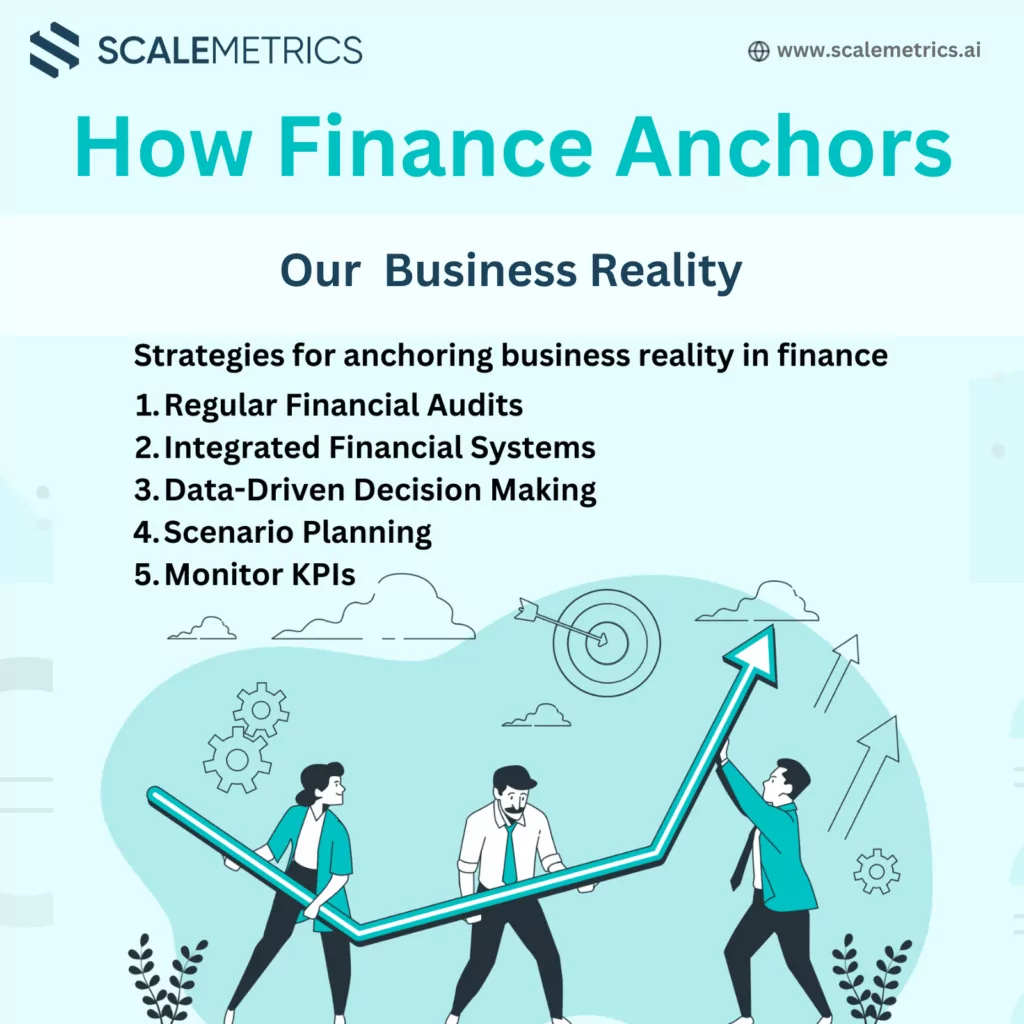
Strategies for Anchoring Business Reality in Finance
- Regular Financial Audits: Conduct regular financial audits to ensure accuracy and compliance. Audits help in identifying discrepancies and areas for improvement. For example, an external audit can provide an independent assessment of a company’s financial statements, ensuring they are free from material misstatement.
- Integrated Financial Systems: Implement integrated financial systems to streamline accounting, budgeting, and reporting processes. This enhances accuracy and provides a holistic view of the company’s financial health. For instance, an enterprise resource planning (ERP) system can integrate various financial functions into a single platform, improving efficiency and data accuracy.
- Data-Driven Decision Making: Use data analytics to inform strategic decisions. Regularly analyze financial and performance data to gain insights and adjust strategies accordingly. For example, using financial dashboards to visualize key metrics and track performance in real-time.
- Scenario Planning: Conduct scenario planning to prepare for various potential outcomes. This helps in making informed decisions under uncertainty and ensures the company is ready for different scenarios. For example, creating financial models to assess the impact of different market conditions on revenue and profitability.
- Performance Metrics: Establish and monitor key performance indicators (KPIs) to track the company’s financial health and operational efficiency. This includes metrics such as gross margin, net profit margin, and return on investment (ROI). Regularly reviewing these metrics helps identify trends and areas for improvement.
Example
A practical example is Netflix, which uses extensive data analytics to inform its content strategy. By analyzing viewer data and financial metrics, Netflix makes data-driven decisions on which shows and movies to produce, ensuring that their investments align with viewer preferences and financial goals. This data-driven approach has helped Netflix maintain its competitive edge and achieve sustainable growth. Another example is Toyota, which employs integrated financial systems and regular audits to ensure accuracy and compliance in its financial reporting. Toyota’s commitment to financial transparency and data-driven decision-making has contributed to its reputation for operational excellence and financial stability.Conclusion
Taking insights from financial and performance reports seriously is critical, ensuring timely intervention before challenges escalate beyond control. By anchoring business reality in finance and adopting a data-driven approach, companies can navigate complexities, make informed decisions, and achieve sustainable growth. Implementing regular audits, integrated financial systems, and scenario planning helps businesses stay on track and build a solid foundation for long-term success.Related Resources
Scalemetrics helps Swiss SMEs act on decisions like this before market conditions shift. Our budgeting and financial forecasting services and outsourced CFO team give finance directors the senior expertise to move first.
Sources & References
Frequently Asked Questions
What financial services does Scalemetrics provide for Swiss SMEs?
Scalemetrics provides Swiss SME owners and CFOs with practical financial expertise: from accounting and tax compliance to financial planning, KPI monitoring, and on-demand CFO services. The goal is to give growing businesses access to senior financial leadership without the cost of a full-time hire.
When does a Swiss SME need a fractional CFO?
A fractional CFO becomes valuable from around CHF 1–2M in annual revenue, or ahead of specific events: bank financing applications, investor rounds, M&A, or rapid growth phases. The cost is a fraction of a full-time CFO salary, with expertise available immediately.
How does Scalemetrics differ from a traditional Swiss fiduciary firm?
Traditional fiduciary firms focus on tax compliance and year-end accounts. Scalemetrics adds strategic financial leadership: rolling forecasts, cash flow modelling, KPI dashboards, and financing advisory, delivered as an ongoing mandate or for a specific project.
Which Swiss cantons does Scalemetrics cover?
Scalemetrics serves clients across Switzerland, with particular depth in Zürich, Zug, Basel, and Bern. Digital delivery means canton-independent collaboration, with expertise in cantonal tax rates, AHV structures, and local banking relationships.
What does a fractional CFO do for a Swiss SME?
A fractional CFO manages the full financial infrastructure of a Swiss SME: OR-compliant bookkeeping, quarterly MWST filings, AHV payroll, budgeting, financial modelling, and board-level reporting. The engagement is part-time and flexible, delivering CFO-level expertise at a fraction of the cost of a full-time hire (CHF 3,000–12,000/month vs CHF 216,000–350,000/year).
When should a Swiss SME engage CFO-as-a-Service?
A Swiss SME typically needs CFO-as-a-Service once annual revenue exceeds CHF 1M, headcount grows beyond 10 employees, or fundraising or M&A activity begins. The fractional model is optimal between CHF 1M and CHF 20M revenue. Above CHF 20M with active deal flow, a full-time CFO hire becomes justified.
Finance as the Anchor of Business Reality
The tension between optimism and analytical rigour is a constant feature of Swiss SME leadership. Founders and commercial leaders bring the energy and conviction that creates growth; finance brings the empirical discipline that ensures that growth is real, sustainable, and quantified accurately. These perspectives are not in opposition — they are complementary, and the most effective Swiss SME leadership teams harness both simultaneously. The risk arises when one dominates the other without adequate checks.
Financial facts — properly prepared management accounts, accurate cash flow statements, and honest variance analysis — serve as the operating reality check that keeps business strategy grounded. When a Swiss SME's finance function is functioning well, it does not simply report what has happened; it challenges assumptions, quantifies risks, and provides the factual foundation from which management can make genuinely informed decisions. This requires both technical accuracy in the numbers and the organisational credibility to present uncomfortable findings without them being dismissed.
The consequences of decisions made on the basis of financial fiction — overstated revenue, understated costs, or optimistic cash flow projections — compound over time. A Swiss SME that consistently makes hiring, investment, and operational decisions on the basis of financial projections that are 20–30% more optimistic than reality will systematically over-invest, under-price, and over-leverage. These errors eventually manifest in the cash position, and the correction — when it comes — is typically more abrupt and painful than a gradual recalibration would have been.
Common Financial Fictions That Swiss SMEs Must Avoid
- Pipeline revenue as committed revenue: Treating sales pipeline as if it were contracted revenue in financial plans overstates near-term cash inflow and distorts the hiring and investment decisions made against it. Risk-adjusted pipeline — applying realistic conversion probabilities at each stage — is the only defensible basis for financial planning.
- Ignoring accrued liabilities: AHV, BVG, and MWST liabilities accrue continuously but are settled periodically. Swiss SMEs that manage cash flow against bank balance rather than against the full liability picture — including these accruals — systematically overstate available resources.
- Depreciation as a discretionary adjustment: Some SME owner-managers treat depreciation as an optional accounting adjustment rather than a real economic cost. The replacement of assets requires cash, and financial plans that exclude adequate provision for this reality create false impressions of margin.
- One-time items as structural improvements: A property sale, a grant receipt, or a one-time contract windfall can flatter a single period's performance. When these items are treated as evidence of structural improvement rather than one-time events, the financial plan built on them will disappoint.
Finance Function Quality: Facts vs. Fiction Indicators
| Area | Fiction (Warning Signs) | Fact (Healthy Indicators) |
|---|---|---|
| Revenue reporting | Cash-based, unreconciled | Accrual, reconciled monthly |
| Forecasting | Best-case only | Base + downside scenarios |
| Variance analysis | Absent or retrospective | Monthly, action-oriented |
| Cash flow | Bank balance monitoring | 13-week rolling forecast |
Building a finance function that consistently delivers facts rather than comfortable fictions is the foundation of sound business management. Our financial controlling service provides Swiss SMEs with the independent, rigorous financial oversight that keeps management information grounded in operational reality.

Pascal Stämpfli leverages over a decade of expertise in corporate finance and venture capital to scale and optimize businesses. A CFA charterholder with a Master's in Economics from the University of St. Gallen, Pascal specializes in market & company assessments, strategy, and business value creation. Having assessed more than 1,000 companies for financial and strategic investors provides him with a sophisticated understanding of investor rationale and capital allocation. As the Managing Director of Scalemetrics and Managing Partner at COREangels Big Data & AI Europe, Pascal operates at the intersection of financial discipline and technological innovation.