
When Great Teams Hit Roadblocks: How Broken Processes Drain Business Performance
Quick Answer
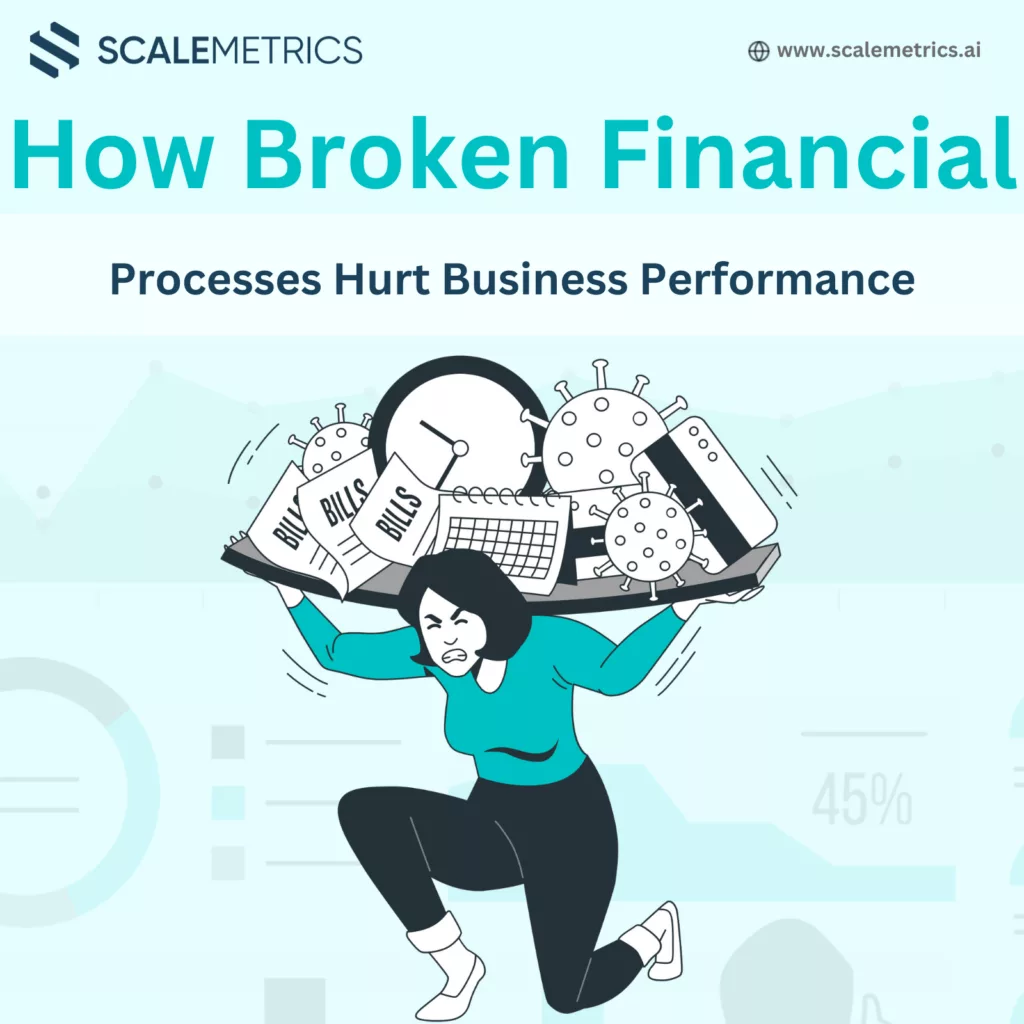
Even great teams can underperform with poor processes. Discover how to align your financial operations with strategy-and boost business results.
You’ve built a strong team. You’ve invested in tools, talent, and maybe even a turbo-charged growth engine. But the results? They’re underwhelming.
Why? Because no matter how good your team is, a bad process can stall progress and silently bleed money from your business.
The Hidden Cost of Broken Processes
Most companies don’t realize just how much inefficiency costs them until it’s too late.
- Bottlenecks slow down decision-making
- Manual tasks waste employee time
- Financial operations lack visibility and control
- Strategic goals feel disconnected from day-to-day actions
And the biggest issue? You’re moving fast-but in the wrong direction.
Why Process Alignment Matters
Processes are the invisible infrastructure that either accelerates or holds back performance. If your systems aren’t aligned with your business goals, it doesn’t matter how talented your team is-you’re not getting where you want to go.
Here’s what alignment looks like in action:
- Financial operations are streamlined, not siloed
- Budgets, forecasts, and reporting tools speak the same language
- Leadership gets real-time data to make faster, smarter decisions
- Every team knows how their work supports company objectives
In short: performance follows direction.
Signs Your Financial Processes Are Costing You
Wondering if your company’s operations are holding you back? Look for these red flags:
- Frequent last-minute budget changes or financial surprises
- Manual reporting that takes days instead of minutes
- Lack of clarity between departments about spending and KPIs
- Misalignment between operational activities and strategic plans
- Difficulty scaling because your financial processes can’t keep up
These symptoms usually point to one root issue: misaligned or outdated processes.
How We Help You Fix the Route
At our core, we help businesses like yours align financial operations with strategic direction, ensuring that processes empower your growth-not sabotage it.
What we deliver:
- End-to-End Financial Process Audits to find bottlenecks, gaps, and inefficiencies
- Custom Financial Systems & Workflows designed around your growth goals
- Performance Dashboards that provide real-time visibility into the numbers that matter
- KPI Alignment to link team performance with financial outcomes
- Automation and Integration to eliminate manual effort and increase accuracy
The result? A business engine that runs smoother, faster, and more efficiently-so you can finally go where you want to.
You Don’t Need a New Team. You Need a Better Route.
Companies often think underperformance means people aren’t doing enough. But more often, people are doing their best with broken systems.
Fix the system, and performance will follow.
Curious where your process is holding you back? Let’s talk.
We’ll help you pinpoint the gaps, realign your operations, and build a financial structure that’s made to scale.
Related Resources
Scalemetrics helps Swiss SMEs act on decisions like this before market conditions shift. Our budgeting and financial forecasting services and outsourced CFO team give finance directors the senior expertise to move first.
Sources & References
Frequently Asked Questions
Why Process Alignment Matters?
Processes are the invisible infrastructure that either accelerates or holds back performance. If your systems aren’t aligned with your business goals, it doesn’t matter how talented your team is, you’re not getting where you want to go.
How We Help You Fix the Route?
At our core, we help businesses like yours align financial operations with strategic direction, ensuring that processes empower your growth, not sabotage it.
What is the more common root cause of underperformance: broken systems or insufficient effort from employees?
Companies often think underperformance means people aren’t doing enough. But more often, people are doing their best with broken systems.
What financial metrics matter most for Swiss SME growth?
The most important financial metrics for Swiss SME growth are gross margin, EBITDA margin, working capital ratio, cash conversion cycle, and monthly cash burn. A fractional CFO builds KPI dashboards tracking these against budget monthly, enabling data-driven decisions rather than reactive cash management.
How does a fractional CFO support Swiss SME scaling?
A fractional CFO supports Swiss SME scaling by building the financial infrastructure needed for growth: management reporting, budgeting and forecasting, financial modelling for new market entry or hiring decisions, investor-grade reporting for fundraising, and tax optimisation across cantons. Scalemetrics provides this as a fully outsourced CFO mandate from CHF 3,000/month.
When Process Failure Drains Business Performance
Great teams can be rendered ineffective by broken processes. This is one of the most underappreciated dynamics in growing Swiss SMEs: a business hires capable, motivated people and then watches performance stagnate because the systems those people operate within are creating friction rather than enabling output. The symptom looks like a people problem — slow decisions, missed deadlines, poor coordination — but the root cause is a process problem, and the correct intervention is operational redesign, not team replacement.
In the finance function specifically, process failure manifests in ways that are directly visible in business results. When the month-end close takes three weeks instead of five days, the leadership team makes the first fortnight of decisions in the following month without knowing last month's actual financial position. When expense approvals require multiple sign-offs across email chains without a defined workflow, both the time cost and the compliance risk are material. When the payroll process requires manual cross-referencing of timesheet data, HR records, and the payroll system, the probability of an AHV or BVG contribution error — with its associated penalty interest — is non-trivial.
The businesses that scale most efficiently are those that treat process design as a leadership responsibility rather than an administrative task. The CFO's role in process design is not to create bureaucracy but to eliminate the variance that makes scaling difficult. A well-designed finance process runs faster with twenty people than the ad hoc version ran with five — because the design absorbs complexity without adding proportional headcount.
Diagnosing Process Failure in Swiss SME Finance Operations
Process failure in finance operations tends to cluster around five areas. The first is data entry duplication: information that enters the system more than once — invoices that are keyed into the accounting system and separately tracked in a spreadsheet, payments that are recorded in the bank portal and separately in the cash flow forecast — creates reconciliation overhead and error risk that grows exponentially with volume.
The second is approval bottlenecks: finance processes that route through one or two senior people for every decision above a low threshold create performance constraints that limit the team's ability to operate independently. Swiss SMEs with rapid growth frequently find that the founder's or CFO's inbox becomes the rate-limiting step in the finance function.
The third is reporting latency: when the management team does not have access to current financial data — because the close process is slow, because the reporting format changes monthly, or because the numbers require interpretation by the finance function before they can be understood — decision quality degrades. The fourth is compliance fragmentation: MWST, AHV, BVG, UVG, and cantonal tax obligations each have different deadlines, calculation bases, and reporting formats. A finance process that treats each of these as a separate, ad hoc task creates unnecessary risk. The fifth is inadequate documentation: processes that exist only in one person's head are not scalable and create catastrophic single-point-of-failure risk.
Process Health Diagnostic for Swiss SME Finance Teams
| Process Area | Healthy Indicator | Failure Indicator |
|---|---|---|
| Month-End Close | Management accounts within 5 days | Accounts delivered 15+ days post-period |
| Payroll Compliance | AHV/BVG accrued monthly, no surprises | Contributions calculated annually, errors found at audit |
| Expense Approvals | Defined workflow, 24-hour turnaround | Ad hoc email chains, multi-week delays |
| Cash Forecasting | Rolling 12-month, updated weekly | Static spreadsheet, updated when needed |
| MWST Compliance | Quarterly amounts pre-calculated and reserved | Calculated at filing deadline, cash available unclear |
Broken finance processes are a performance drain that compounds with growth. Our financial controlling service redesigns the finance operating model for Swiss SMEs — eliminating friction, reducing error, and building the process infrastructure that supports the team to perform at its best.

Pascal Stämpfli leverages over a decade of expertise in corporate finance and venture capital to scale and optimize businesses. A CFA charterholder with a Master's in Economics from the University of St. Gallen, Pascal specializes in market & company assessments, strategy, and business value creation. Having assessed more than 1,000 companies for financial and strategic investors provides him with a sophisticated understanding of investor rationale and capital allocation. As the Managing Director of Scalemetrics and Managing Partner at COREangels Big Data & AI Europe, Pascal operates at the intersection of financial discipline and technological innovation.