
How to refine your business strategy in four steps?
Quick Answer
Improve your business strategy with a four-step process. Learn to perform SWOT analysis, set objectives, and achieve goals.
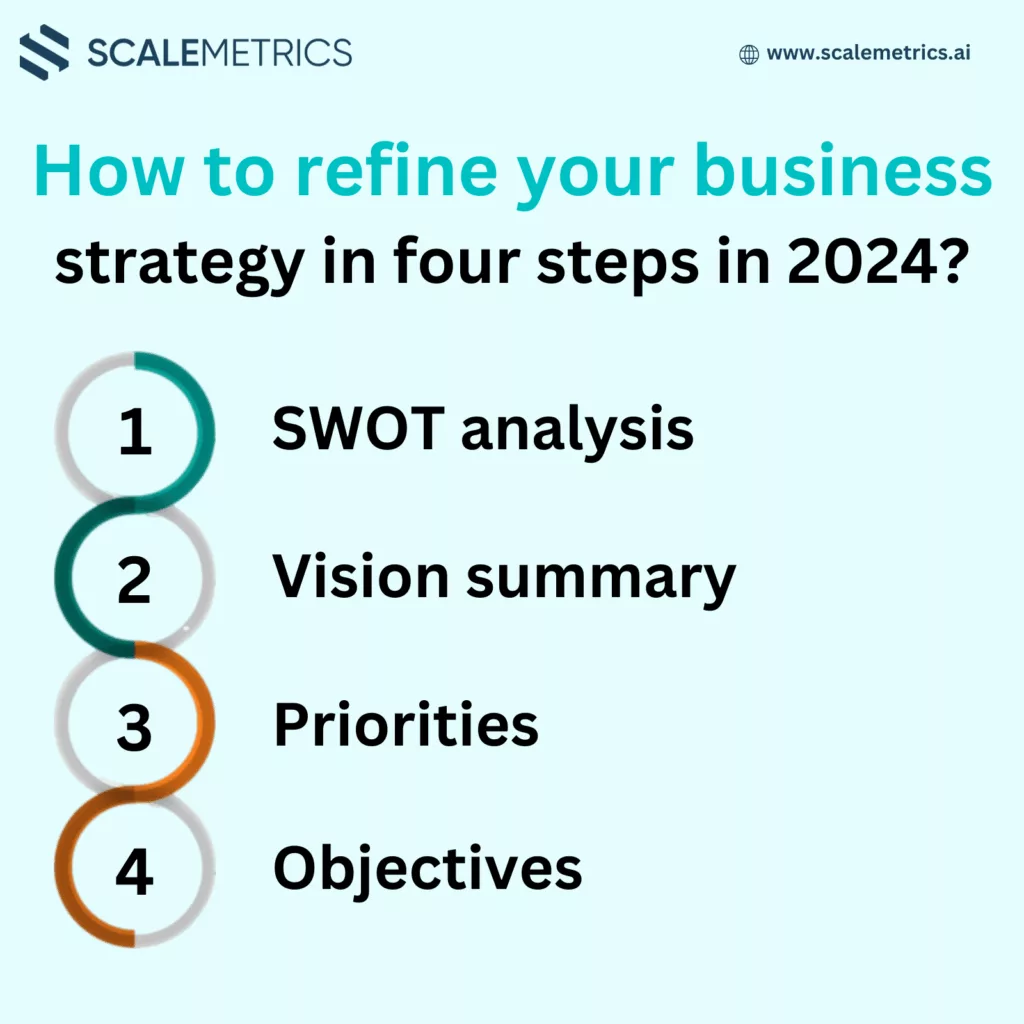
1. Conduct a SWT Analysis
Performing a Strengths, Weaknesses, and Trends (SWT) Analysis helps you understand your company’s internal capabilities and the external environment. This assessment provides a clear picture of your current situation and how it might evolve over time.- Strengths: Identify what your company does well. These could be resources, capabilities, or competencies that give you an advantage over competitors.
- Weaknesses: Recognize areas where your company needs improvement. This can help you allocate resources more effectively and avoid potential pitfalls.
- Trends: Understand the industry and market trends that can impact your business. This includes technological advancements, regulatory changes, and shifts in consumer behavior.
2. Develop a Vision Summary
A Vision Summary builds engagement, alignment, and focus throughout the company. It provides a one-page format to communicate key aspects of your company’s vision to employees, customers, investors, and the wider community. The vision summary should include the following components:- Core Values: Define the principles that shape your company’s culture and personality. These values guide behavior and decision-making within the organization.
- Purpose: State your startup’s reason for existence. This combines elements of the mission statement, vision, and values into a single, compelling statement.
- Brand Promise: Articulate the value or experience that customers can expect every time they interact with your company. Consistently delivering on this promise strengthens brand loyalty.
- BHAG (Big Hairy Audacious Goal): Set a clear and compelling long-term goal (10 years or more) that inspires and motivates your team to think beyond short-term objectives.
- Priorities: Outline where the company should focus over the next quarter, year, and three to five years. These priorities help align daily activities with long-term goals.
3. Set and Delegate Objectives
Once you have a clear vision summary, the next step is to set specific, measurable objectives and delegate responsibilities:- Objective Setting: Break down your vision into actionable objectives. These should be specific, measurable, achievable, relevant, and time-bound (SMART).
- Delegation: The CEO should assign tasks to employees based on their skills and strengths. Effective delegation ensures that each team member contributes to achieving the company’s goals.
4. Create and Implement a Reporting Process
A well-implemented Business Monitoring & Controlling system ensures that the strategy is executed efficiently. It helps to set the right incentives, identify bottlenecks promptly, and take corrective action in time.- Identify KPIs: Determine the key performance indicators that align with your strategic objectives. These KPIs should provide insights into your progress and highlight areas needing attention.
- Benchmarking: Set ambitious yet achievable benchmarks. Regularly compare your KPIs against these benchmarks to gauge performance.
- Reporting Routine: Develop a consistent and efficient reporting process. This ensures that you regularly review performance and make informed decisions.
- Corrective Actions: Define a set of rules for evaluating and implementing corrective actions when KPIs deviate from the benchmarks. This allows you to address issues promptly and keep the strategy on track.
Conclusion
A well-crafted business strategy is crucial for driving growth and attracting investors. By conducting a thorough SWT analysis, developing a compelling vision summary, setting clear objectives, and implementing an effective business monitoring and controlling system, you can refine your strategy to achieve your company’s goals. What are your thoughts on the strategy and iterative process outlined above? Kindly let us know.Related Resources
Scalemetrics helps Swiss SMEs act on decisions like this before market conditions shift. Our budgeting and financial forecasting services and outsourced CFO team give finance directors the senior expertise to move first.
Sources & References
Frequently Asked Questions
What financial services does Scalemetrics provide for Swiss SMEs?
Scalemetrics provides Swiss SME owners and CFOs with practical financial expertise: from accounting and tax compliance to financial planning, KPI monitoring, and on-demand CFO services. The goal is to give growing businesses access to senior financial leadership without the cost of a full-time hire.
When does a Swiss SME need a fractional CFO?
A fractional CFO becomes valuable from around CHF 1–2M in annual revenue, or ahead of specific events: bank financing applications, investor rounds, M&A, or rapid growth phases. The cost is a fraction of a full-time CFO salary, with expertise available immediately.
How does Scalemetrics differ from a traditional Swiss fiduciary firm?
Traditional fiduciary firms focus on tax compliance and year-end accounts. Scalemetrics adds strategic financial leadership: rolling forecasts, cash flow modelling, KPI dashboards, and financing advisory, delivered as an ongoing mandate or for a specific project.
Which Swiss cantons does Scalemetrics cover?
Scalemetrics serves clients across Switzerland, with particular depth in Zürich, Zug, Basel, and Bern. Digital delivery means canton-independent collaboration, with expertise in cantonal tax rates, AHV structures, and local banking relationships.
What financial metrics matter most for Swiss SME growth?
The most important financial metrics for Swiss SME growth are gross margin, EBITDA margin, working capital ratio, cash conversion cycle, and monthly cash burn. A fractional CFO builds KPI dashboards tracking these against budget monthly, enabling data-driven decisions rather than reactive cash management.
How does a fractional CFO support Swiss SME scaling?
A fractional CFO supports Swiss SME scaling by building the financial infrastructure needed for growth: management reporting, budgeting and forecasting, financial modelling for new market entry or hiring decisions, investor-grade reporting for fundraising, and tax optimisation across cantons. Scalemetrics provides this as a fully outsourced CFO mandate from CHF 3,000/month.
Why Strategy Refinement Must Be a Deliberate Process
Swiss SMEs that set annual strategies and then execute against them without review are, in effect, steering by yesterday's map. Markets shift, competitive landscapes evolve, and the assumptions underlying last year's strategy become progressively less reliable. Deliberate, structured strategy refinement — not a wholesale annual overhaul, but a regular, evidence-driven recalibration — is how high-performing SMEs maintain strategic relevance without the disruption of constant reinvention.
The four-step approach to strategy refinement follows a logical sequence: assess your current position honestly (what is working, what is not, and why); clarify where you want to be (what specific outcomes define success in the next 12–24 months); identify the gaps between current position and desired state; and define the prioritised initiatives that will close those gaps. Each step requires financial data — current performance metrics, cost modelling for proposed initiatives, and scenario analysis for alternative paths.
Under OR Art. 716a, the board of directors of a Swiss AG bears non-delegable responsibility for the overall direction of the company and the organisation of management. Strategy refinement is therefore not merely a management prerogative — it is a board obligation. SMEs that formalise their strategy review process, supported by rigorous financial analysis, demonstrate the governance maturity that banks, investors, and key clients increasingly expect.
Step 1: Honest Assessment of Current Position
An honest current-state assessment requires three inputs: financial performance data (revenue trend, margin analysis, cash conversion), operational KPIs (customer retention, sales pipeline health, service delivery metrics), and market intelligence (competitive positioning, customer feedback, regulatory changes). Without all three, the assessment is incomplete.
Swiss-specific cost benchmarking is essential to this step. If your gross margin is below the industry average for Swiss professional services (typically 55–70%) or Swiss software (typically 65–80%), this is a signal worth investigating. If your personnel cost ratio exceeds 55–60% of revenue for a service business — after accounting for AHV at 5.3%, BVG at 8–12%, SUVA, and salary — you may have a structural cost problem that the strategy must address.
Steps 2–4: From Gap Analysis to Prioritised Initiatives
Once the current state is clear, the gap to the desired state can be quantified. Not all gaps are equal: some represent existential risks (rapidly declining CRR, negative cash flow trend), whilst others represent growth opportunities (underserved market segments, underpriced products). Prioritisation should weight initiatives by financial impact, cost of implementation, and strategic alignment — not by internal political momentum.
Each initiative must have a financial model attached: what will it cost to implement (including fully-loaded personnel time), what revenue or cost benefit will it generate, over what timeframe, and with what degree of certainty? Initiatives without financial models are wishes, not strategies.
| Step | Key Question | Primary Data Input |
|---|---|---|
| 1. Assess current position | Where are we today? | Financial statements, KPI dashboard |
| 2. Clarify desired state | Where do we want to be? | Strategic objectives, board mandate |
| 3. Gap analysis | What is missing? | Variance analysis, competitive benchmarks |
| 4. Prioritise initiatives | What do we do first? | Financial models, risk-adjusted ROI |
To run a structured strategy refinement process for your Swiss SME — backed by rigorous financial analysis and scenario modelling — our strategic CFO services provide the independent perspective and financial expertise your leadership team needs.

Pascal Stämpfli leverages over a decade of expertise in corporate finance and venture capital to scale and optimize businesses. A CFA charterholder with a Master's in Economics from the University of St. Gallen, Pascal specializes in market & company assessments, strategy, and business value creation. Having assessed more than 1,000 companies for financial and strategic investors provides him with a sophisticated understanding of investor rationale and capital allocation. As the Managing Director of Scalemetrics and Managing Partner at COREangels Big Data & AI Europe, Pascal operates at the intersection of financial discipline and technological innovation.