
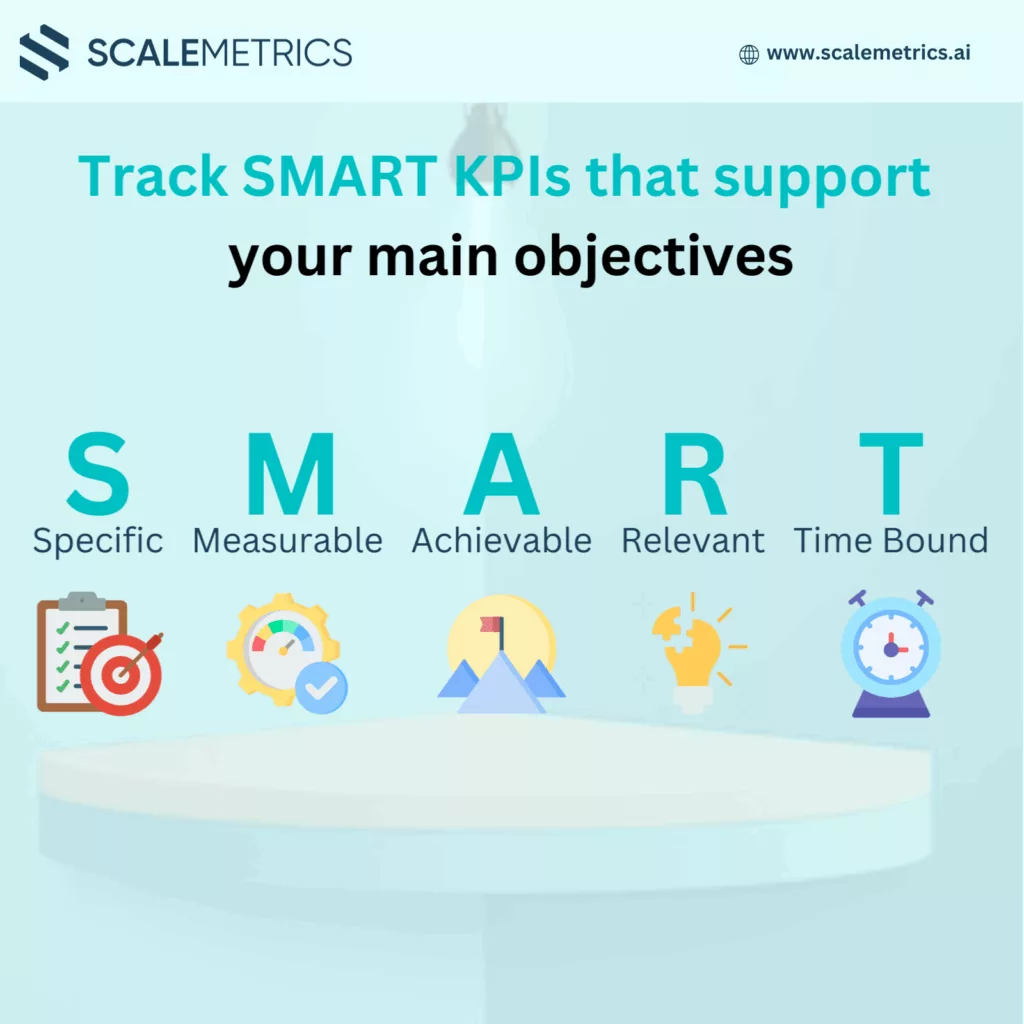
Track SMART KPIs that support your main objectives
Quick Answer
You can benefit the most from your business monitoring & controlling system by tracking & benchmarking SMART KPIs in your startup
Benefits of Tracking SMART KPIs
- Enhanced Focus: Clear objectives and measurable KPIs help your team stay focused on what matters most.
- Improved Decision-Making: Data-driven insights from tracking KPIs support better decision-making.
- Increased Accountability: Regular tracking and reporting create a culture of accountability.
- Strategic Alignment: Ensures all efforts are aligned with the organization’s strategic goals.
- Performance Optimization: Identifies areas for improvement and enables timely corrective actions.
Steps to Implement SMART KPIs
- Define and Set Your Main Objective
- Start by defining your primary goal. This should be a broad, long-term objective that aligns with your company’s vision and mission.
- Example: For a SaaS company, the main objective could be to increase customer satisfaction by 20% year over year.
- Divide the Main Objective into Weekly or Monthly Goals
- Break down the main objective into smaller, manageable parts. This makes it easier to track progress and make adjustments.
- Example: If the annual goal is to increase customer satisfaction by 20%, the monthly goal would be to increase it by approximately 1.53%.
- Track KPIs that Support These Goals
- Identify and monitor KPIs that are directly related to your objectives.
- Example: To improve customer satisfaction, track KPIs such as response time for customer support, ease of installation, and the development of requested features.
Characteristics of SMART KPIs
- Specific
- Ensure your KPIs are clearly defined and directly related to your main objective.
- Example: “Reduce customer support response time to under 2 hours.”
- Measurable
- KPIs should be quantifiable to track progress accurately.
- Example: “Achieve a Net Promoter Score (NPS) of 70 or higher.”
- Achievable
- Set realistic and attainable KPIs to keep your team motivated.
- Example: “Increase customer retention rate by 5% over the next quarter.”
- Relevant
- KPIs should be relevant to your main objectives and reflect the areas that need improvement.
- Example: “Reduce the number of installation steps to enhance user experience.”
- Timely
- Define a clear timeline for achieving the KPIs to maintain a sense of urgency and focus.
- Example: “Develop and release the top three customer-requested features within six months.”
Implementing SMART KPIs: A SaaS Company Example
Let’s assume you are a SaaS company and your main objective is to increase customer satisfaction by 20% year over year. Here’s how you can implement SMART KPIs to achieve this goal:- Monthly Goal: Increase customer satisfaction by 1.53% each month.
- Specific KPIs:
- Reduce customer support response time to under 2 hours.
- Simplify installation by reducing the number of steps from 10 to 5.
- Develop and release the top three customer-requested features within six months.
- Measurable KPIs:
- Track the average response time for customer support.
- Measure the number of steps in the installation process.
- Monitor the development progress of requested features.
- Achievable KPIs:
- Ensure that the goals are realistic based on your team’s capabilities and resources.
- Relevant KPIs:
- Focus on metrics that directly impact customer satisfaction and retention.
- Timely KPIs:
- Set deadlines for each KPI to maintain momentum and focus.
Conclusion
Tracking SMART KPIs results in a comprehensive overview of progress towards your goals and further improves your decision-making ability. By implementing these steps, you can ensure that your organization stays aligned with its main objectives, optimizes performance, and achieves sustainable growth.Related Resources
Scalemetrics helps Swiss SMEs act on decisions like this before market conditions shift. Our business monitoring services and outsourced CFO team give finance directors the senior expertise to move first.
Sources & References
Frequently Asked Questions
What financial services does Scalemetrics provide for Swiss SMEs?
Scalemetrics provides Swiss SME owners and CFOs with practical financial expertise: from accounting and tax compliance to financial planning, KPI monitoring, and on-demand CFO services, giving growing businesses access to senior financial leadership without a full-time hire.
When does a Swiss SME need a fractional CFO?
A fractional CFO becomes valuable from around CHF 1–2M in annual revenue, or ahead of specific events: bank financing applications, investor rounds, M&A, or rapid growth phases. The cost is a fraction of a full-time CFO salary, with expertise available immediately.
How does Scalemetrics differ from a traditional Swiss fiduciary firm?
Traditional fiduciary firms focus on tax compliance and year-end accounts. Scalemetrics adds strategic financial leadership: rolling forecasts, cash flow modelling, KPI dashboards, and financing advisory, delivered as an ongoing mandate or for a specific project.
Which Swiss cantons does Scalemetrics cover?
Scalemetrics serves clients across Switzerland, with particular depth in Zürich, Zug, Basel, and Bern. Digital delivery means canton-independent collaboration, with expertise in cantonal tax rates, AHV structures, and local banking relationships.
How much does a fractional CFO engagement cost in Switzerland?
Pricing depends on scope and frequency. Typical SME engagements start from CHF 1’500–3’000 per month for a core package and scale with business complexity. An initial consultation is free of charge.
Why SMART KPIs Are the Foundation of Swiss SME Performance Management
The difference between a Swiss SME that grows predictably and one that grows chaotically is rarely the quality of its product or service. It is almost always the quality of its performance measurement. Businesses that track SMART KPIs — Specific, Measurable, Achievable, Relevant, and Time-bound — have an operational advantage because they make decisions based on evidence rather than intuition. In a high-cost environment like Switzerland, where every mis-hire, every lost client, and every margin-eroding contract has amplified consequences, evidence-based management is not a luxury. It is a survival mechanism.
The most common mistake Swiss SMEs make with KPIs is tracking too many metrics that do not connect to strategic objectives. A management dashboard with fifteen indicators is not more informative than one with five — it is less informative, because the signal is buried in noise. Effective KPI design starts by asking: what are the two or three outcomes that, if achieved, would confirm we are on track to meet our annual plan? All KPIs should serve as leading or lagging indicators of those outcomes.
For a Swiss professional services firm, the strategic objectives might be: grow recurring revenue to CHF 2 million, maintain a gross margin above 55%, and retain 90% of clients year-on-year. The SMART KPIs supporting these objectives would include: new retainer contracts signed per month (leading indicator for revenue), time billed as a percentage of total available hours (leading indicator for margin), and net promoter score or client renewal rate (leading indicator for retention). Each metric is specific, measurable, and directly connected to a strategic outcome.
Connecting KPIs to Swiss Regulatory and Financial Realities
Swiss SME KPIs must account for the structural cost realities of operating in Switzerland. The total employment cost burden — AHV at 5.3% employer contribution, ALV at 1.1%, BVG contributions ranging from 8% to 12% of insured salary depending on age bracket, and SUVA accident insurance — means that revenue per FTE benchmarks must be calibrated to Swiss norms, not global averages. A CHF 200,000 revenue per FTE target is conservative for Swiss professional services; a CHF 150,000 target may signal a structural margin problem.
Cash conversion efficiency is a critical KPI for Swiss SMEs that is often absent from management dashboards. This metric — calculated as operating cash flow divided by EBITDA — reveals how efficiently profit converts into cash. A business with strong EBITDA but poor cash conversion is typically suffering from high debtor days or inventory build-up. Swiss OR payment terms of 30 days net are routinely extended to 45–60 days in practice; monitoring debtor days as a KPI and setting a maximum threshold (typically 35 days for Swiss B2B) creates accountability for collections discipline.
| Strategic Objective | SMART KPI | Target (Swiss SME Benchmark) |
|---|---|---|
| Revenue growth | New contracted revenue per quarter | Minimum 15% YoY increase |
| Margin preservation | Gross margin % by service line | ≥ 50% (services), ≥ 25% (products) |
| Cash health | Debtor days outstanding | ≤ 35 days |
| Team productivity | Revenue per FTE | CHF 180k–250k (services) |
Building a KPI framework that is genuinely connected to your strategy — rather than a generic template — is part of the structured work that a financial controlling engagement delivers. The goal is a dashboard that prompts action, not one that is reviewed and filed.

Pascal Stämpfli leverages over a decade of expertise in corporate finance and venture capital to scale and optimize businesses. A CFA charterholder with a Master's in Economics from the University of St. Gallen, Pascal specializes in market & company assessments, strategy, and business value creation. Having assessed more than 1,000 companies for financial and strategic investors provides him with a sophisticated understanding of investor rationale and capital allocation. As the Managing Director of Scalemetrics and Managing Partner at COREangels Big Data & AI Europe, Pascal operates at the intersection of financial discipline and technological innovation.