
How customer acquisition cost (CAC) metric is related to scalability
Quick Answer
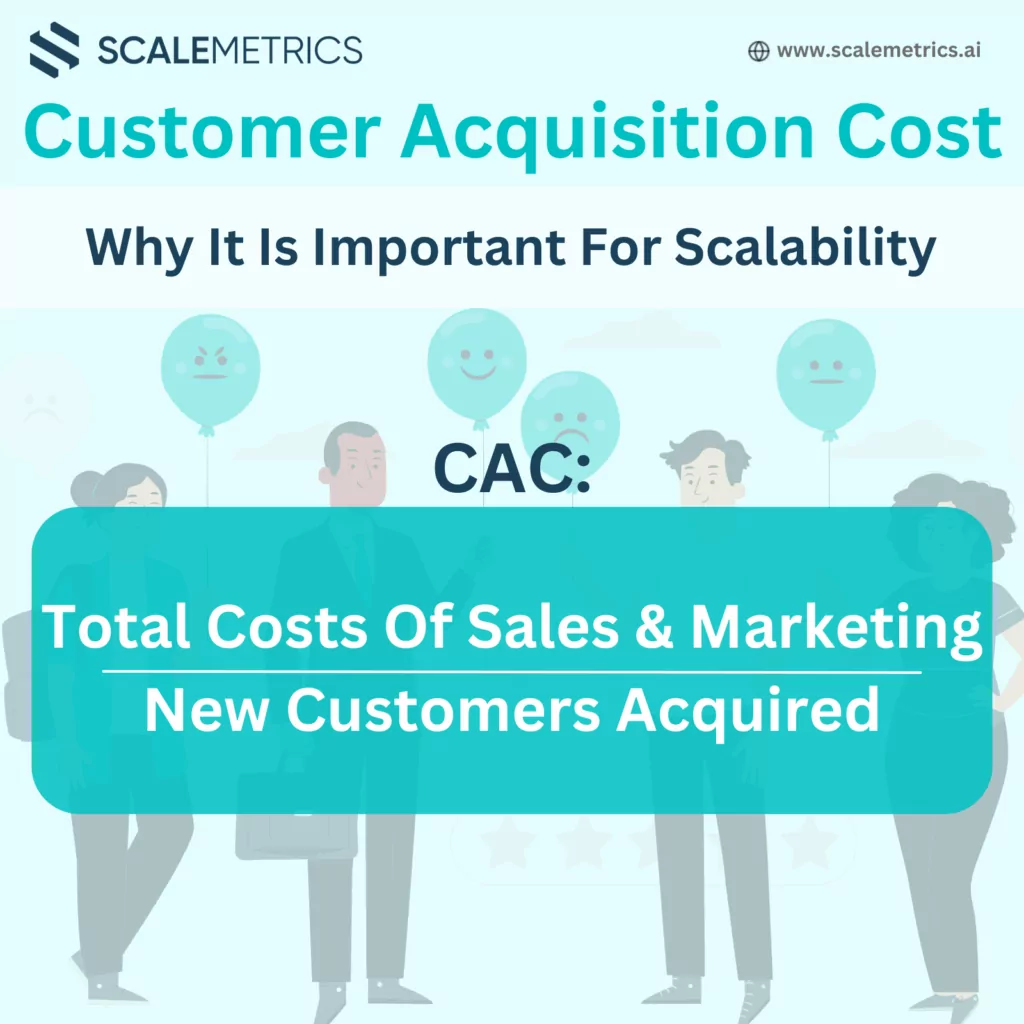
The cost of acquiring a new customer is referred to as customer acquisition cost (CAC), an important metric that demonstrates the scalability.
Understanding and Calculating CAC
CAC is calculated using the formula: CAC=TCSM/NCA where:- CAC refers to Customer Acquisition Cost
- TCSM refers to Total Cost of Sales and Marketing (e.g., ads, PPC campaigns, SEO, offline advertising, and any other marketing and sales costs related to attracting new customers)
- NCA refers to New Customers Acquired
Example Calculation
Let’s look at an example to see how the formula works: if you spent $10,000 on marketing and sales and acquired 100 new customers, the CAC would be: CAC=$10,000/100=$100Key Drivers of CAC
Understanding the main drivers of your CAC is essential for optimization. These drivers include:- Lead Generation:
- A significant portion of your budget will be spent on lead generation.
- Assessing the cost of leads helps identify the most effective channels for attracting potential customers.
- Qualifying Leads:
- An efficient process for qualifying leads can optimize the entire sales process, resulting in lower CAC.
- This involves evaluating the quality and timing of leads to ensure they are ready for conversion.
- Engagement with Leads:
- The number and duration of interactions and touchpoints with leads will impact your customer acquisition costs.
- Effective engagement strategies can streamline the sales process and reduce the time and resources needed to convert leads into customers.
- Conversion Rate:
- A higher conversion rate generally reduces customer acquisition costs, as the above drivers are minimized on a per-client basis.
- Improving the conversion rate ensures that a higher proportion of leads turn into paying customers, thereby lowering the overall CAC.
Optimizing CAC
You can extract relevant information from these drivers to optimize your customer acquisition costs. Here are some strategies:- Focus on High-Quality Leads:
- Prioritize marketing efforts on channels that generate the highest quality leads, which are more likely to convert.
- Streamline the Sales Process:
- Implement tools and techniques to make the sales process more efficient, such as CRM systems and automated follow-up sequences.
- Enhance Lead Qualification:
- Develop criteria for lead scoring to prioritize high-potential leads and ensure that sales efforts are focused on the most promising prospects.
- Improve Conversion Tactics:
- Train sales teams on effective conversion strategies, such as personalized communication, objection handling, and closing techniques.
CAC and Scalability
While CAC alone cannot define your company’s scalability, the ratio of CAC to Customer Lifetime Value (CLV) does. A favorable CLV to CAC ratio indicates that your business is effectively converting marketing and sales efforts into long-term customer value, which is a key indicator of scalability.Conclusion
Understanding and optimizing your Customer Acquisition Cost (CAC) is essential for demonstrating the scalability of your business. By focusing on the key drivers of CAC and implementing strategies to improve lead generation, qualification, engagement, and conversion rates, you can reduce acquisition costs and enhance your company’s growth potential. In the next article, we will cover the CLV ratio to further explore how these metrics impact scalability and profitability.Related Resources
Scalemetrics helps Swiss SMEs act on decisions like this before market conditions shift. Our financial due diligence services and outsourced CFO team give finance directors the senior expertise to move first.
Sources & References
Frequently Asked Questions
What financial services does Scalemetrics provide for Swiss SMEs?
Scalemetrics provides Swiss SME owners and CFOs with practical financial expertise: from accounting and tax compliance to financial planning, KPI monitoring, and on-demand CFO services. The goal is to give growing businesses access to senior financial leadership without the cost of a full-time hire.
When does a Swiss SME need a fractional CFO?
A fractional CFO becomes valuable from around CHF 1–2M in annual revenue, or ahead of specific events: bank financing applications, investor rounds, M&A, or rapid growth phases. The cost is a fraction of a full-time CFO salary, with expertise available immediately.
How does Scalemetrics differ from a traditional Swiss fiduciary firm?
Traditional fiduciary firms focus on tax compliance and year-end accounts. Scalemetrics adds strategic financial leadership: rolling forecasts, cash flow modelling, KPI dashboards, and financing advisory, delivered as an ongoing mandate or for a specific project.
Which Swiss cantons does Scalemetrics cover?
Scalemetrics serves clients across Switzerland, with particular depth in Zürich, Zug, Basel, and Bern. Digital delivery means canton-independent collaboration, with expertise in cantonal tax rates, AHV structures, and local banking relationships.
What financial documents do Swiss investors and banks require?
Swiss investors and banks typically require three years of OR-compliant financial statements, a 3–5 year financial model, a 13-week cash flow forecast, a cap table, and KPI dashboards. Series A investors additionally expect audited accounts and unit economics. Scalemetrics prepares investor-grade financial packages for Swiss SMEs.
How does a fractional CFO help Swiss SMEs raise financing?
A fractional CFO improves Swiss SME financing outcomes by building the financial model, preparing OR-compliant statements, structuring the data room, and presenting financials credibly to banks or investors. SMEs with a proper finance function secure better terms and faster credit decisions. Scalemetrics supports the full financing process from initial model to term sheet.
Customer Acquisition Cost as a Scalability Constraint
Customer acquisition cost (CAC) measures the total investment required to convert a prospect into a paying customer. For Swiss SMEs targeting scalable growth, CAC is not merely a marketing metric — it is a fundamental constraint on how fast you can grow without exhausting your capital. A business with a high CAC and a limited balance sheet can acquire customers, but it cannot do so at scale without running out of cash.
The relationship between CAC and scalability is mediated by payback period: the number of months required for the gross margin generated by a new customer to recover the cost of acquiring them. In Switzerland, where fully-loaded sales and marketing personnel costs are high — reflecting AHV employer contributions at 5.3%, BVG pension costs at 8–12%, and above-European-average salary benchmarks — the CAC of a typical B2B SME is often CHF 3,000–8,000 per customer. A payback period of 12–18 months is generally considered acceptable for software and service businesses; beyond 24 months creates meaningful liquidity risk.
This matters particularly for Swiss SMEs that rely on bank financing rather than venture capital to fund growth. Swiss cantonal banks and commercial lenders scrutinise cash conversion cycles carefully. A business with a 30-month CAC payback period will find it difficult to demonstrate a convincing credit case — regardless of how strong the long-term CLV:CAC ratio appears.
Decomposing CAC to Find Scalability Leverage
True CAC is not simply your monthly marketing spend divided by new customers acquired. It must include: marketing platform costs, content production, event and conference fees, the fully-loaded cost of your sales team (salaries, social charges, tools, travel), and a fair allocation of management time spent on sales oversight. Many Swiss SMEs underestimate CAC by 30–50% by omitting personnel cost components.
Once you have an accurate CAC figure, decompose it by acquisition channel. Digital channels typically show lower CAC than conference or relationship-driven channels but generate lower-quality leads. Referral programmes often produce the lowest CAC of all and the highest-quality customers. Understanding which channels deliver the best CAC-to-LTV ratio allows you to allocate acquisition budget rationally rather than by convention.
MWST (VAT) treatment also affects your effective CAC calculation. If your marketing spend includes significant input tax — advertising, events, consultant fees — and you are a full VAT taxpayer at 8.1%, the net cost of that spend is lower than the gross invoice amount. Modelling CAC on gross spend overstates the true acquisition cost for VAT-registered businesses.
CAC and Capital Efficiency in the Swiss Growth Context
Capital efficiency — the revenue generated per franc of capital deployed — is closely linked to CAC. Businesses with low CAC and short payback periods can grow without disproportionate capital consumption. Businesses with high CAC must either raise external financing, grow more slowly, or find structural ways to reduce acquisition cost.
| CAC Component | Typical % of Total CAC | Swiss-Specific Note |
|---|---|---|
| Sales personnel (fully loaded) | 50–65% | AHV 5.3%, BVG 8–12% add ~20% to gross salary |
| Paid marketing | 15–25% | Net of recoverable MWST for VAT taxpayers |
| Events & trade shows | 10–20% | Higher in Switzerland due to venue costs |
| Tools & technology | 5–10% | CRM, marketing automation, analytics |
To build a precise CAC model for your Swiss SME and identify the channels that offer the best scalability economics, our financial planning team can help you design the right analytical framework.

Pascal Stämpfli leverages over a decade of expertise in corporate finance and venture capital to scale and optimize businesses. A CFA charterholder with a Master's in Economics from the University of St. Gallen, Pascal specializes in market & company assessments, strategy, and business value creation. Having assessed more than 1,000 companies for financial and strategic investors provides him with a sophisticated understanding of investor rationale and capital allocation. As the Managing Director of Scalemetrics and Managing Partner at COREangels Big Data & AI Europe, Pascal operates at the intersection of financial discipline and technological innovation.