
How improving customer retention rate (crr) impacts your business
Quick Answer
Customer retention rate (crr) measures the ability of a company to regularly serve its existing customers in exchange for money.
Understanding Customer Retention
Customer retention reflects your company’s ability to create lasting value and maintain profitable relationships over time. It involves understanding and expanding customer needs, leading to increased purchases over time. High customer retention rates indicate strong customer loyalty and satisfaction.Calculating Customer Retention Rate
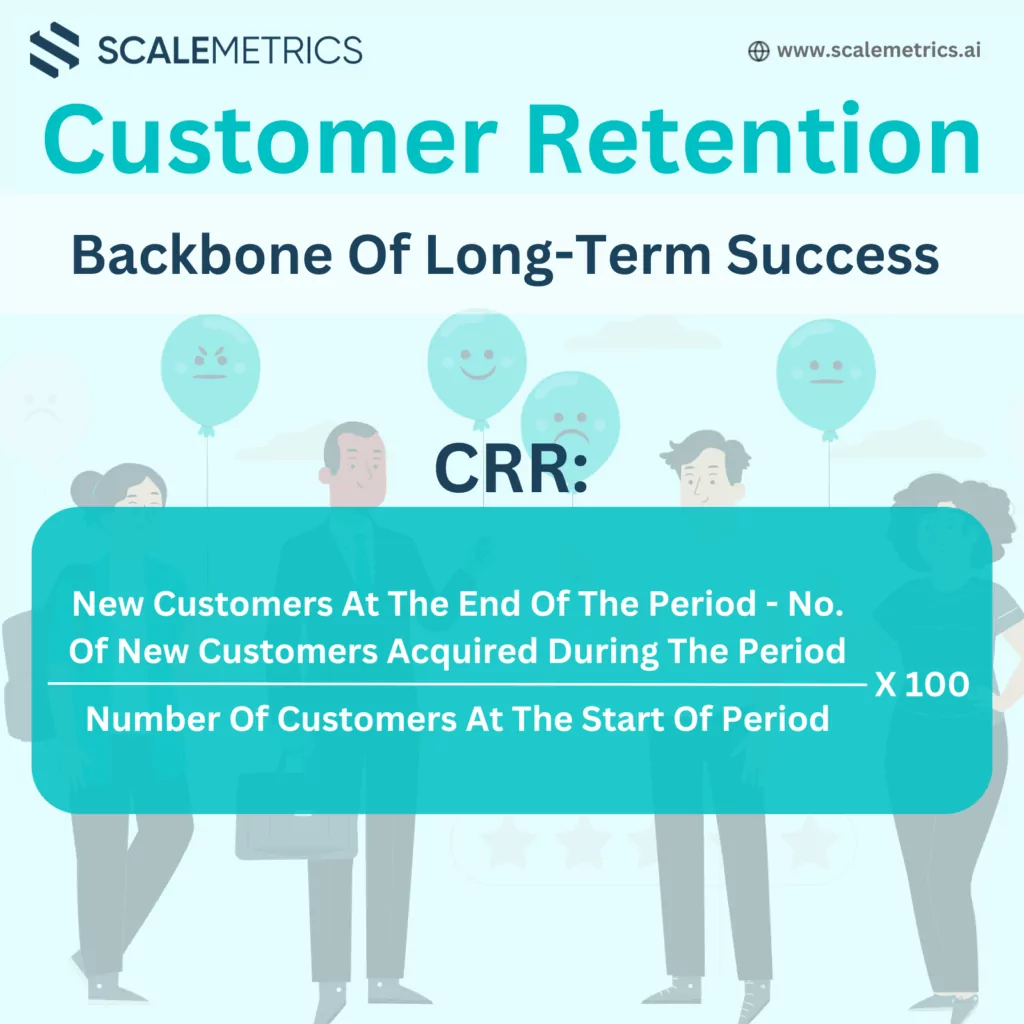
To calculate customer retention for your business, subtract the new customers acquired during a predetermined period from the total number of customers at the end of that period and divide that number by the number of customers at the beginning of the period. The formula is: (No. of Customers at End of Period – No. of Customers Acquired During Period) / No. of Customers at Start of Period For example, if you have 24 customers at the end of a quarter, gained five new customers during that period, and served 20 customers at the beginning, your customer retention rate is 95%, as shown below: (24−5)/20=95%Industry Benchmarks
The average customer retention rate varies across industries, according to a recent study by Statista. The overall average retention rate is 75%, and by industry, it is as follows:- IT Services: 81%
- Healthcare: 77%
- Professional Services: 84%
- Media: 84%
- Financial Services: 78%
- IT & Software: 77%
Actions to Improve Customer Retention
- Create a Great Onboarding Experience: Ensure that new customers are introduced to your product or service in a way that maximizes their satisfaction and minimizes any initial confusion or frustration.
- Provide a Personalized Customer Experience: Use CRM systems to track customer preferences and behaviors. Personalized communication makes customers feel valued and understood.
- Implement a Customer Feedback Loop: Regularly seek customer feedback and use it to improve your products and services. This demonstrates that you value their input and are committed to meeting their needs.
- Build Trust with Your Customers: Transparency and honesty are crucial in building trust. Ensure that your business practices are ethical and that you consistently meet customer expectations.
- Maintain a Customer Communication Calendar: Regular communication, such as newsletters or updates, keeps customers engaged with your brand and informs them of new products or services.
- Create a Strong Brand: A strong brand identity helps retain customers by creating a sense of loyalty and connection to your company.
- Shift to a Subscription-Based Business Model: This model can improve retention by ensuring regular customer interaction and continuous service provision.
Benefits of High Customer Retention Rate
- Predictable Revenue: With a high customer retention rate, revenue becomes more predictable, allowing for better financial planning and stability.
- Higher Profitability: Retained customers typically have a higher lifetime value, contributing more to your bottom line over time.
- Reduced Dependency on Customer Acquisition: With high retention, your business is less reliant on constantly acquiring new customers to sustain revenue, reducing marketing and sales costs.
Example
Amazon is a prime example of a company with exceptional customer retention strategies. Through its Amazon Prime membership, personalized recommendations, and proactive customer support, Amazon has built a loyal customer base that consistently returns for repeat purchases. Amazon’s focus on customer satisfaction and continuous improvement has contributed to its success and market leadership.Conclusion
Customer retention is indeed an important metric to track and improve. If you do, you can expect higher sales predictability, higher customer lifetime value, and higher profitability. Your business will become much more attractive to yourself, your employees, and investors.Related Resources
Scalemetrics helps Swiss SMEs act on decisions like this before market conditions shift. Our budgeting and financial forecasting services and outsourced CFO team give finance directors the senior expertise to move first.
Sources & References
Frequently Asked Questions
What financial services does Scalemetrics provide for Swiss SMEs?
Scalemetrics provides Swiss SME owners and CFOs with practical financial expertise: from accounting and tax compliance to financial planning, KPI monitoring, and on-demand CFO services. The goal is to give growing businesses access to senior financial leadership without the cost of a full-time hire.
When does a Swiss SME need a fractional CFO?
A fractional CFO becomes valuable from around CHF 1–2M in annual revenue, or ahead of specific events: bank financing applications, investor rounds, M&A, or rapid growth phases. The cost is a fraction of a full-time CFO salary, with expertise available immediately.
How does Scalemetrics differ from a traditional Swiss fiduciary firm?
Traditional fiduciary firms focus on tax compliance and year-end accounts. Scalemetrics adds strategic financial leadership: rolling forecasts, cash flow modelling, KPI dashboards, and financing advisory, delivered as an ongoing mandate or for a specific project.
Which Swiss cantons does Scalemetrics cover?
Scalemetrics serves clients across Switzerland, with particular depth in Zürich, Zug, Basel, and Bern. Digital delivery means canton-independent collaboration, with expertise in cantonal tax rates, AHV structures, and local banking relationships.
The Financial Logic of Customer Retention for Swiss SMEs
Customer retention rate (CRR) is among the most financially significant metrics a Swiss SME can track, yet it is frequently absent from management reporting. The reason it matters so profoundly is straightforward: acquiring a new customer costs between five and seven times more than retaining an existing one. For a Swiss SME with a customer acquisition cost (CAC) of CHF 2,000, a one-percentage-point improvement in CRR delivers the economic equivalent of eliminating CHF 10,000–14,000 of annual acquisition spend.
The relationship between CRR and revenue predictability is equally important. A business with 90% annual retention can model its forward revenue with reasonable confidence, allowing tighter cash flow management and more credible budget assumptions. A business with 70% retention is replacing nearly a third of its customer base each year — a treadmill that consumes marketing budget, sales capacity, and management attention without generating net growth.
Swiss subscription businesses and B2B service providers are particularly sensitive to this dynamic. When you factor in AHV employer contributions at 5.3%, BVG pension costs, and the relatively high Swiss salary benchmarks, the fully-loaded cost of a customer success or account management function is substantial. That investment only generates positive ROI if retention rates justify it.
Quantifying the Revenue Impact of CRR Improvements
The compounding effect of retention improvements is non-linear. A SaaS or recurring-revenue SME with CHF 5 million ARR and a current CRR of 85% retains CHF 4.25 million of that base annually. Improving CRR to 90% retains CHF 4.5 million — an additional CHF 250,000 in preserved revenue that costs nothing incremental to acquire. Over three years, with modest new customer growth layered on top, the compounding difference between 85% and 90% retention can amount to several hundred thousand francs in cumulative ARR.
Customer lifetime value (CLV) rises directly with CRR. If your average customer generates CHF 12,000 per year in revenue and your CRR moves from 80% to 90%, average customer tenure extends from 5 years to 10 years, and CLV doubles from CHF 60,000 to CHF 120,000 — assuming constant revenue per customer. This transformation in CLV changes the economics of your entire acquisition strategy: you can afford to invest more in acquiring high-quality customers precisely because you keep them longer.
Operational Levers for Improving Retention
Improving CRR is not a marketing exercise — it is an operational and product discipline. The most reliable levers are: delivering consistent product or service quality that matches customer expectations set during the sales process; proactive engagement at key risk moments (contract renewal, onboarding friction, support escalations); and creating genuine switching costs through integrations, data portability, and relationship depth.
| CRR Level | Avg. Customer Tenure | CLV at CHF 12k/yr Revenue | Annual Churn Cost (CHF 5M ARR) |
|---|---|---|---|
| 70% | 3.3 years | CHF 40,000 | CHF 1,500,000 |
| 80% | 5.0 years | CHF 60,000 | CHF 1,000,000 |
| 90% | 10.0 years | CHF 120,000 | CHF 500,000 |
| 95% | 20.0 years | CHF 240,000 | CHF 250,000 |
To build the financial models that quantify your retention economics and inform your customer success investment decisions, explore our financial planning services for Swiss SMEs.

Pascal Stämpfli leverages over a decade of expertise in corporate finance and venture capital to scale and optimize businesses. A CFA charterholder with a Master's in Economics from the University of St. Gallen, Pascal specializes in market & company assessments, strategy, and business value creation. Having assessed more than 1,000 companies for financial and strategic investors provides him with a sophisticated understanding of investor rationale and capital allocation. As the Managing Director of Scalemetrics and Managing Partner at COREangels Big Data & AI Europe, Pascal operates at the intersection of financial discipline and technological innovation.