
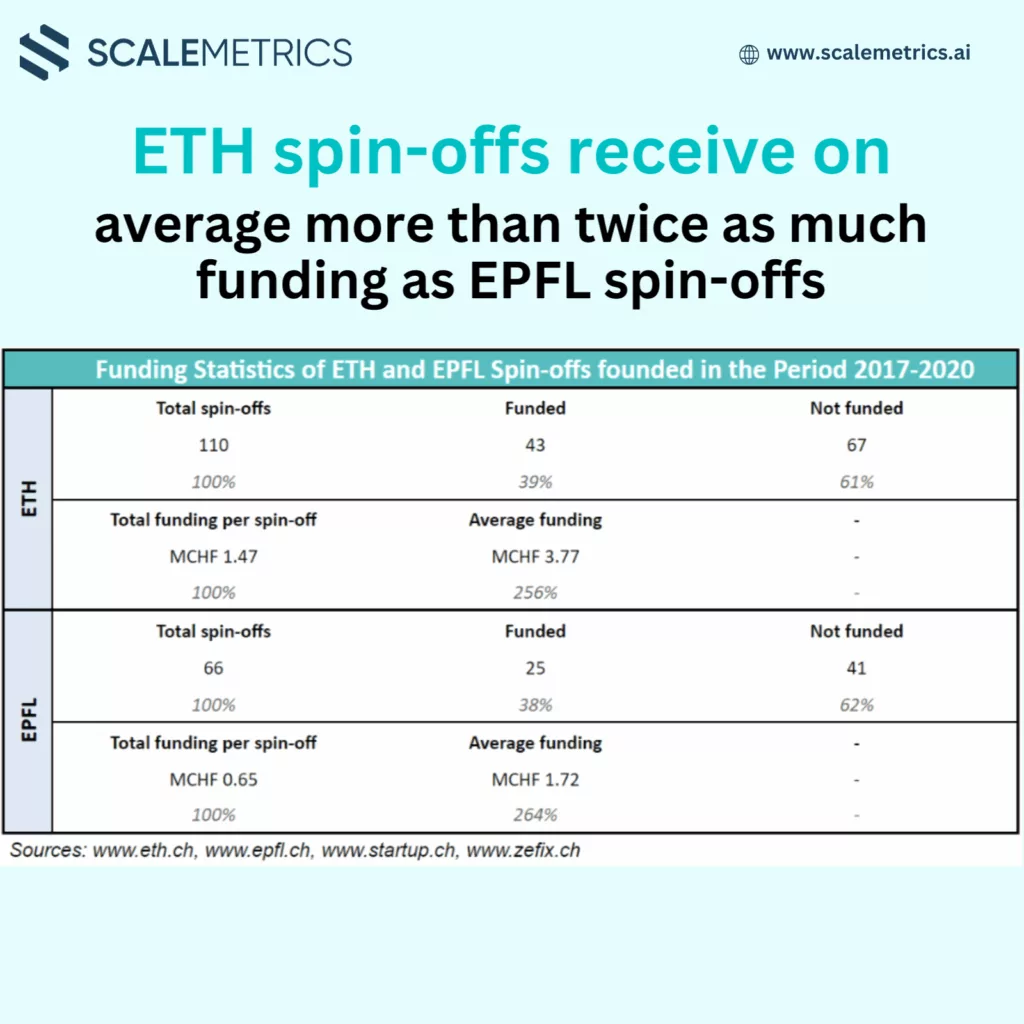
ETH spin-offs receive on average more than twice as much funding as EPFL spin-offs.
Quick Answer
The evaluation of ETH and EPFL spin-offs launched in the period 2017 to 2020 showed that 39% of ETH and 38% of EPFL spin-offs received some form of third-party funding.
Funding Overview
Proportion of Funded Spin-Offs
- ETH Spin-Offs: 39% received third-party funding.
- EPFL Spin-Offs: 38% received third-party funding.
Average Funding per Spin-Off
- ETH Spin-Offs: CHF 1.47 million per spin-off.
- EPFL Spin-Offs: CHF 0.65 million per spin-off.
Average Funding per Funded Spin-Off
- ETH Spin-Offs: CHF 3.77 million per funded spin-off.
- EPFL Spin-Offs: CHF 1.72 million per funded spin-off.
Analysis of Funding Differences
Despite the nearly identical proportion of funded spin-offs, the average amount of funding per funded spin-off is significantly higher for ETH compared to EPFL. Several factors might contribute to this disparity:Economic Attractiveness of Developed Technologies
- ETH: Known for its strengths in high-impact fields like robotics, artificial intelligence, and biotechnology, which often attract substantial investor interest and funding.
- EPFL: Although strong in areas such as energy, materials science, and microengineering, these sectors might not attract as high a level of investment compared to ETH’s focus areas.
Availability of Professional Support
- ETH: May offer more extensive professional support services, including mentorship, business development resources, and networking opportunities, which can enhance the attractiveness of its spin-offs to investors.
- EPFL: While also providing significant support, it might have fewer resources or less visibility in global investor networks compared to ETH.
Venture Capital Scene
- ETH: Located in Zurich, ETH spin-offs benefit from proximity to a vibrant venture capital scene and strong connections with international investors.
- EPFL: Situated in Lausanne, EPFL spin-offs might have less access to a diverse and large pool of venture capital compared to Zurich.
Future Analysis
To further understand the reasons behind the funding disparity, an analysis of the number and type of funding rounds for each institution’s spin-offs will be conducted. This includes examining seed rounds, Series A, Series B, and other types of financing. Additionally, assessing investor profiles and market trends could provide more insights into the factors driving these differences.Call for Insights
If you have specific insights or concrete indications about the reasons for the significant funding differences between ETH and EPFL spin-offs, please feel free to contact us. Your contributions can help enrich this ongoing analysis and provide a clearer picture of the startup funding landscape.Related Resources
Scalemetrics helps Swiss SMEs act on decisions like this before market conditions shift. Our company valuation services and outsourced CFO team give finance directors the senior expertise to move first.
Sources & References
Frequently Asked Questions
What financial services does Scalemetrics provide for Swiss SMEs?
Scalemetrics provides Swiss SME owners and CFOs with practical financial expertise: from accounting and tax compliance to financial planning, KPI monitoring, and on-demand CFO services. The goal is to give growing businesses access to senior financial leadership without the cost of a full-time hire.
When does a Swiss SME need a fractional CFO?
A fractional CFO becomes valuable from around CHF 1–2M in annual revenue, or ahead of specific events: bank financing applications, investor rounds, M&A, or rapid growth phases. The cost is a fraction of a full-time CFO salary, with expertise available immediately.
How does Scalemetrics differ from a traditional Swiss fiduciary firm?
Traditional fiduciary firms focus on tax compliance and year-end accounts. Scalemetrics adds strategic financial leadership: rolling forecasts, cash flow modelling, KPI dashboards, and financing advisory, delivered as an ongoing mandate or for a specific project.
Which Swiss cantons does Scalemetrics cover?
Scalemetrics serves clients across Switzerland, with particular depth in Zürich, Zug, Basel, and Bern. Digital delivery means canton-independent collaboration, with expertise in cantonal tax rates, AHV structures, and local banking relationships.
What financial documents do Swiss investors and banks require?
Swiss investors and banks typically require three years of OR-compliant financial statements, a 3–5 year financial model, a 13-week cash flow forecast, a cap table, and KPI dashboards. Series A investors additionally expect audited accounts and unit economics. Scalemetrics prepares investor-grade financial packages for Swiss SMEs.
How does a fractional CFO help Swiss SMEs raise financing?
A fractional CFO improves Swiss SME financing outcomes by building the financial model, preparing OR-compliant statements, structuring the data room, and presenting financials credibly to banks or investors. SMEs with a proper finance function secure better terms and faster credit decisions. Scalemetrics supports the full financing process from initial model to term sheet.
The ETH Funding Premium: Understanding the Data
Analysis of funding data for ETH Zurich and EPFL spin-offs founded between 2017 and 2022 reveals a consistent pattern: ETH spin-offs have received, on average, more than twice as much cumulative funding as their EPFL counterparts by equivalent stages of development. This is one of the most striking differentials in the Swiss venture ecosystem and raises important questions about the structural factors that drive funding outcomes for Swiss university spin-offs.
The aggregate funding differential is not simply a reflection of more spin-offs from ETH: on a per-company basis, ETH spin-offs have consistently commanded higher valuations and attracted larger individual round sizes. Life sciences and medtech spin-offs are particularly pronounced contributors to this differential — ETH's proximity to the Basel pharma cluster and Zurich-based medtech corporate investors creates a deal flow environment that channels larger capital commitments to ETH ventures than the equally strong EPFL life sciences pipeline has historically accessed.
The differential is narrowing. EPFL's investment in its innovation ecosystem — through the EPFL Innovation Park, the strengthened relationship with EPFL Technology Transfer, and the growing Geneva and Lausanne venture capital infrastructure — has produced measurable improvement in funding outcomes for EPFL spin-offs in the 2020–2022 cohort relative to 2017–2019. The trend line suggests continued convergence, though a meaningful gap persists at the current time.
Structural Factors Behind the Differential
Four structural factors explain the majority of the ETH-EPFL funding gap. First, ecosystem maturity: Zurich has a deeper, more established venture capital infrastructure than the Lausanne-Geneva corridor, with a larger number of Swiss and international VC offices actively deploying capital into Swiss deep-tech and life sciences. Second, corporate venture capital access: the Basel pharma giants (Roche, Novartis), Zurich financial services firms, and major industrials (ABB, Georg Fischer) maintain corporate venture arms or strategic investment programmes that disproportionately source deal flow from ETH's network. Third, serial entrepreneur density: Zurich has a higher concentration of successful serial entrepreneurs who angel-invest in ETH spin-offs, providing early-stage capital that de-risks ventures before institutional investors engage. Fourth, exit liquidity: the stronger Swiss-German acquisition market — including German Mittelstand companies and DACH technology consolidators — creates a more proximate exit environment for ETH ventures in certain sectors.
It is important to note that funding volume does not straightforwardly equate to superior outcomes. EPFL spin-offs in software, AI, and certain cleantech categories have achieved strong returns on more modest capital raises — reflecting the capital efficiency advantages of software-centric business models. The funding differential is most pronounced in capital-intensive sectors (life sciences, hardware, deep materials science) where the Swiss-German investment ecosystem provides a structural advantage to ETH-affiliated ventures.
What This Means for Founders of Swiss University Spin-Offs
For EPFL spin-offs navigating a funding process in 2026, the data suggests three practical implications. First, investors outside Switzerland — particularly French, British, and pan-European VCs with strong life sciences or deeptech mandates — are active and receptive to EPFL-originated deals, providing an alternative to the Swiss-centric funding channels that disproportionately favour ETH. Second, non-dilutive public funding (InnoSuisse, SNSF BRIDGE, EU Horizon Europe) is a particularly important runway-extension mechanism for EPFL spin-offs seeking to reach stronger commercial proof points before their first equity raise. Third, cross-institution co-founding teams — combining ETH technical expertise with EPFL commercial networks, or vice versa — have demonstrated the ability to bridge both ecosystems and access funding from both Zurich and Lausanne-Geneva based investors.
| Funding Dimension | ETH Spin-Offs (2017–2022) | EPFL Spin-Offs (2017–2022) |
|---|---|---|
| Average cumulative funding | Materially higher | Strong but lower |
| Primary capital source | Swiss / DACH VCs, corporate CVCs | Swiss, French, pan-European VCs |
| Strongest sectors | Life sciences, medtech, materials | ICT, cleantech, life sciences |
| Gap trend | — | Narrowing since 2020 |
Whether you are an ETH or EPFL spin-off preparing for your next funding round, our investor readiness services provide the financial preparation, valuation modelling, and investor narrative expertise to maximise your funding outcomes in the Swiss and European market.
Pascal Stämpfli leverages over a decade of expertise in corporate finance and venture capital to scale and optimize businesses. A CFA charterholder with a Master's in Economics from the University of St. Gallen, Pascal specializes in market & company assessments, strategy, and business value creation. Having assessed more than 1,000 companies for financial and strategic investors provides him with a sophisticated understanding of investor rationale and capital allocation. As the Managing Director of Scalemetrics and Managing Partner at COREangels Big Data & AI Europe, Pascal operates at the intersection of financial discipline and technological innovation.