
Funding type statistics of ETH & EPFL Spin-offs founded between 2017-2020
Quick Answer
Analyze funding types for ETH & EPFL spin-offs from 2017-2020. Learn trends and strategies for securing investment.
Funding Overview
Seed Rounds
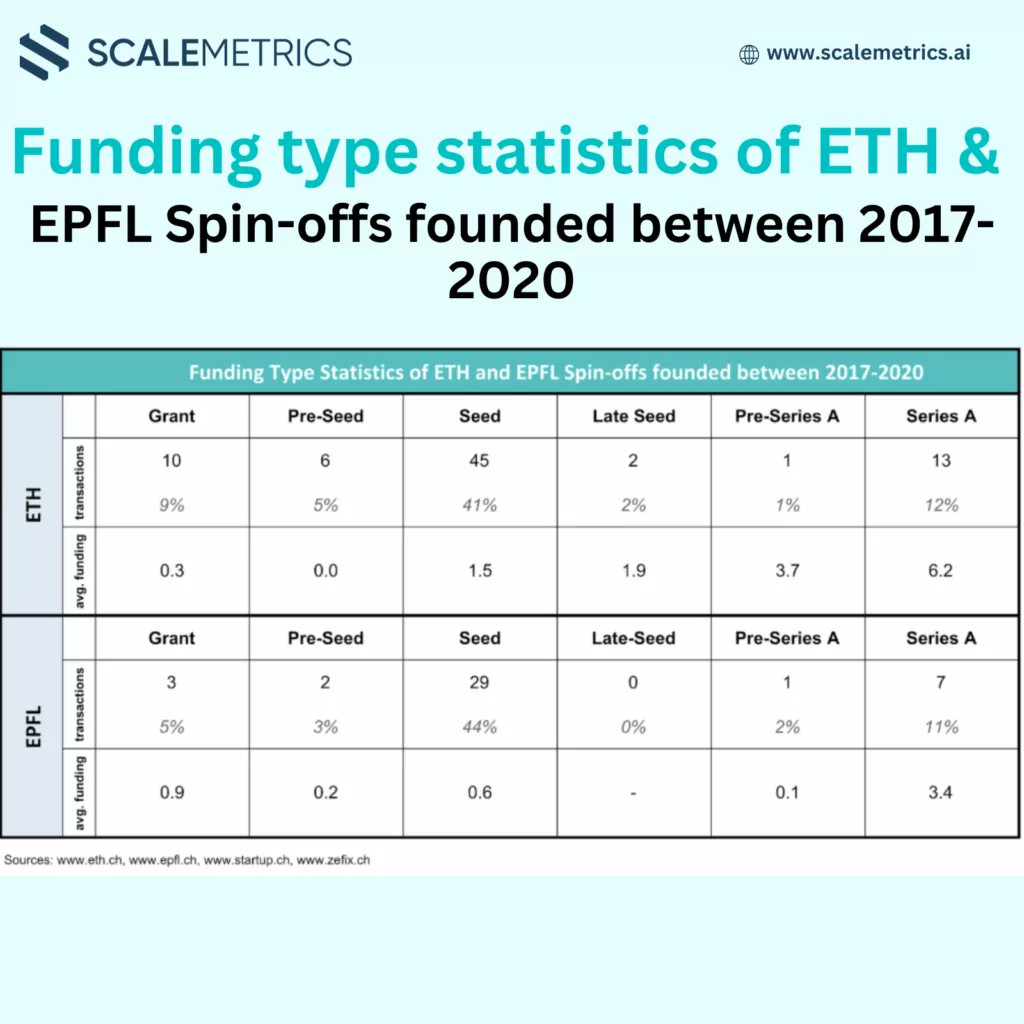
- ETH Spin-offs: 41% raised a seed round with an average funding amount of CHF 1.5 million.
- EPFL Spin-offs: 44% raised a seed round with an average funding amount of CHF 0.6 million.
Series A Rounds
- ETH Spin-offs: 12% received Series A funding, averaging CHF 6.2 million.
- EPFL Spin-offs: 11% received Series A funding, averaging CHF 3.4 million.
Grants
- ETH Spin-offs: Higher likelihood of receiving grants compared to EPFL spin-offs.
- EPFL Spin-offs: Although fewer grants were received, the average amount for grants tends to be higher, particularly in the French-speaking part.
Strategies to Increase Your Probability of Being Well-Funded
Seed Phase
- Target a Large Market: Ensure that your spin-off addresses a market substantial enough to attract investor interest.
- Develop Disruptive Technology: Create technology that disrupts existing solutions and is difficult for competitors to replicate.
- Build a Strong Core Team: Assemble a team with the necessary skills and experience, and establish a robust network within your field.
- Run Pilot Projects: Conduct initial pilot projects with potential customers to validate your technology and demonstrate its market potential.
Beyond the Seed Stage
Focus on finding product-market fit. Investors will commit larger sums to your company once they are convinced of your ability to scale with reasonable unit economics.Case Study: ETH vs. EPFL Spin-offs
Funding Amounts
- ETH Spin-offs: The higher average funding amounts in both seed and Series A rounds suggest a greater confidence from investors in these spin-offs, possibly due to their robust market strategies and disruptive technologies.
- EPFL Spin-offs: Despite receiving lower average funding amounts, the consistency in receiving seed rounds indicates a solid foundation that can be built upon by enhancing product-market fit and demonstrating scalability.
Regional Differences
- German-speaking Part: Spin-offs here received significantly higher funding amounts, indicating a more vibrant venture capital scene and possibly better access to professional support.
- French-speaking Part: Higher average grant amounts suggest a strong support system for early-stage funding, but the lower overall funding highlights the need for better integration with larger venture capital networks.
Key Takeaways for Spin-offs
Focus Areas for Seed Phase
- Market Size: Clearly demonstrate the potential market size to investors.
- Technology Disruption: Highlight how your technology is unique and difficult to replicate.
- Team Strength: Showcase the expertise and cohesiveness of your team.
- Customer Validation: Present data from pilot projects that validate your product’s market fit.
Moving to Series A and Beyond
- Product-Market Fit: Continuously refine your product to ensure it meets market demands effectively.
- Scalability: Develop and present a clear plan showing how your business can scale efficiently with reasonable unit economics.
Conclusion
By understanding the funding landscape and adopting strategies that align with investor expectations, both ETH and EPFL spin-offs can enhance their attractiveness to potential investors. Focusing on market size, technology disruption, team strength, and customer validation during the seed phase, and ensuring product-market fit and scalability beyond that, are critical steps towards securing substantial funding and achieving sustainable growth. Find the article on find product market fitRelated Resources
Scalemetrics helps Swiss SMEs act on decisions like this before market conditions shift. Our SME financing services and outsourced CFO team give finance directors the senior expertise to move first.
Sources & References
Frequently Asked Questions
What financial services does Scalemetrics provide for Swiss SMEs?
Scalemetrics provides Swiss SME owners and CFOs with practical financial expertise: from accounting and tax compliance to financial planning, KPI monitoring, and on-demand CFO services. The goal is to give growing businesses access to senior financial leadership without the cost of a full-time hire.
When does a Swiss SME need a fractional CFO?
A fractional CFO becomes valuable from around CHF 1–2M in annual revenue, or ahead of specific events: bank financing applications, investor rounds, M&A, or rapid growth phases. The cost is a fraction of a full-time CFO salary, with expertise available immediately.
How does Scalemetrics differ from a traditional Swiss fiduciary firm?
Traditional fiduciary firms focus on tax compliance and year-end accounts. Scalemetrics adds strategic financial leadership: rolling forecasts, cash flow modelling, KPI dashboards, and financing advisory, delivered as an ongoing mandate or for a specific project.
Which Swiss cantons does Scalemetrics cover?
Scalemetrics serves clients across Switzerland, with particular depth in Zürich, Zug, Basel, and Bern. Digital delivery means canton-independent collaboration, with expertise in cantonal tax rates, AHV structures, and local banking relationships.
What financial documents do Swiss investors and banks require?
Swiss investors and banks typically require three years of OR-compliant financial statements, a 3–5 year financial model, a 13-week cash flow forecast, a cap table, and KPI dashboards. Series A investors additionally expect audited accounts and unit economics. Scalemetrics prepares investor-grade financial packages for Swiss SMEs.
How does a fractional CFO help Swiss SMEs raise financing?
A fractional CFO improves Swiss SME financing outcomes by building the financial model, preparing OR-compliant statements, structuring the data room, and presenting financials credibly to banks or investors. SMEs with a proper finance function secure better terms and faster credit decisions. Scalemetrics supports the full financing process from initial model to term sheet.
Funding Type Distribution: What the ETH and EPFL Data Reveals
The funding type mix for ETH and EPFL spin-offs founded between 2017 and 2024 reveals important insights about how Swiss university ventures are capitalised across their development lifecycle. Understanding this distribution helps founders of Swiss spin-offs and growth-stage SMEs to plan their funding sequencing more effectively and to set realistic expectations about which capital sources are available at which stages.
Non-dilutive public funding — grants from InnoSuisse, SNSF, and EU Horizon Europe — represents a disproportionately large share of early-stage capital for both ETH and EPFL spin-offs compared to most other European innovation ecosystems. Switzerland's well-funded public innovation support infrastructure enables spin-offs to reach higher levels of technical and commercial validation before their first equity round than is possible in countries with less generous grant programmes. This non-dilutive capital is typically used for proof-of-concept work, prototype development, and early market validation — activities that, if funded with equity, would require founders to accept significant dilution at the lowest valuation point in their company's history.
Seed equity rounds — typically CHF 500,000 to CHF 3 million — follow grant funding in the standard Swiss spin-off capital lifecycle. These rounds are predominantly sourced from Swiss angel investors, family offices, and early-stage venture funds such as Founderful, Wingman Ventures, and Verve Ventures. The 2017–2024 cohort data shows that the time between first grant funding and first equity round has shortened over the period, reflecting both improved investor readiness amongst founders and increased investor comfort with Swiss university spin-off risk profiles.
Series A and Growth Capital Patterns
Series A rounds — typically CHF 5 million to CHF 20 million for Swiss companies — represent the point at which international capital begins to play a significant role. The 2017–2024 cohort shows a clear pattern: Swiss seed rounds are predominantly domestic in their investor composition, whilst Series A and later rounds attract increasing proportions of European and occasionally US institutional capital. This internationalisation of the investor base at Series A reflects both the growth in company scale (which justifies larger international fund commitments) and the demonstrated commercial proof that Series A milestones require.
Corporate venture capital (CVC) is a significant and growing component of the Swiss spin-off funding mix. Pharma CVCs (Roche Ventures, Novartis Venture Fund), technology CVCs (Swisscom Ventures), and industrial CVCs (Siemens Next47, ABB Technology Ventures) collectively account for a material share of funding in the 2017–2024 cohort, particularly for life sciences and deeptech ventures where strategic alignment between the spin-off and a corporate investor creates mutual value beyond the financial return. CVC investors typically bring domain expertise, pilot customer relationships, and acquisition optionality — considerations that are worth valuing alongside the financial terms of their investment.
The tax implications of funding type matter for Swiss SME financial planning. Grant income from InnoSuisse and SNSF is typically not subject to corporate income tax, but the precise treatment depends on the grant structure, the purpose of the funds, and the cantonal tax authority's interpretation. Equity investment itself is not income, but the premium above nominal share value creates share premium reserves that have specific accounting and distribution implications under OR Art. 671 et seq. Founders should engage their tax adviser and CFO at each funding stage to ensure the treatment is correct.
Planning Your Funding Sequence Based on the Data
The ETH/EPFL 2017–2024 cohort data suggests an optimal funding sequencing model for Swiss spin-offs: maximise non-dilutive public funding at the earliest stages, use seed equity to reach Series A-ready milestones, and target international institutional capital at Series A with a strong Swiss anchor investor. Deviating from this sequence — particularly by raising equity too early, before grant options have been fully exploited — results in unnecessary dilution at low valuations.
| Funding Type | Typical Stage | Primary Source (Swiss) |
|---|---|---|
| Non-dilutive grants | Pre-seed / R&D phase | InnoSuisse, SNSF BRIDGE, EU Horizon |
| Seed equity | Post-PoC, pre-commercial | Swiss angels, Founderful, Verve, Investiere |
| Series A (institutional) | First commercial revenue | VI Partners, ZKB ventures, European VCs |
| Corporate VC | Any post-seed stage | Roche, Novartis, Swisscom, ABB ventures |
To plan your funding sequence with financial rigour and prepare investor-ready documentation for each round, our investor readiness services help Swiss spin-offs and SMEs navigate the capital raising process with confidence and precision.
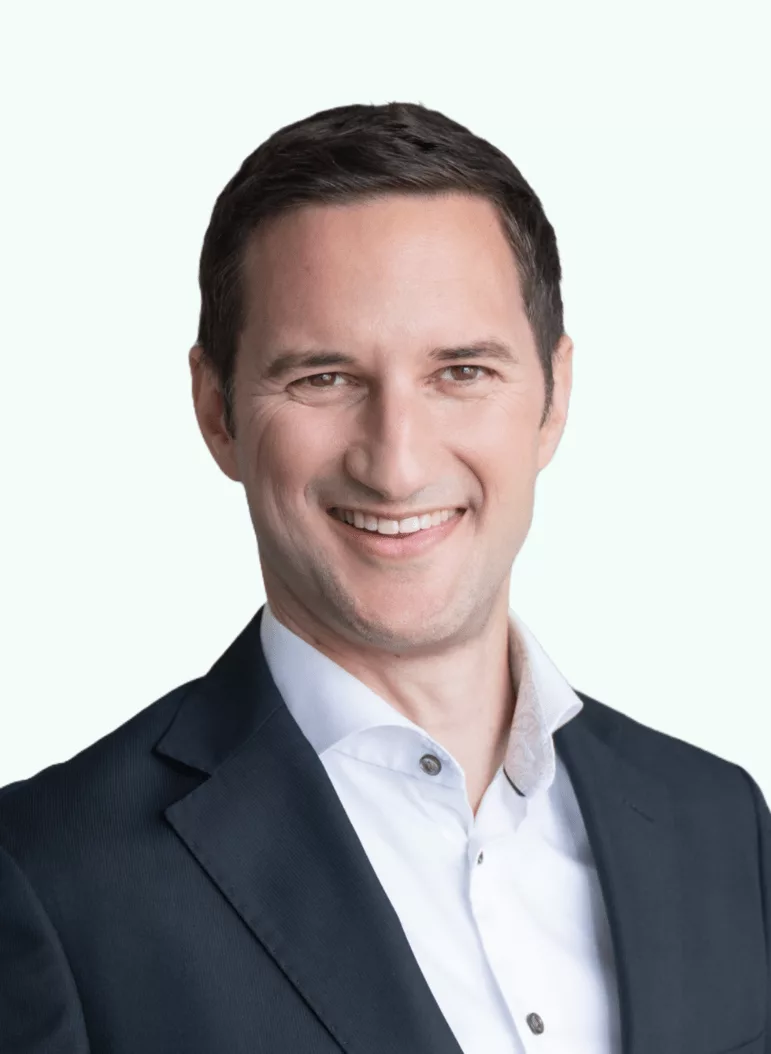
Pascal Stämpfli leverages over a decade of expertise in corporate finance and venture capital to scale and optimize businesses. A CFA charterholder with a Master's in Economics from the University of St. Gallen, Pascal specializes in market & company assessments, strategy, and business value creation. Having assessed more than 1,000 companies for financial and strategic investors provides him with a sophisticated understanding of investor rationale and capital allocation. As the Managing Director of Scalemetrics and Managing Partner at COREangels Big Data & AI Europe, Pascal operates at the intersection of financial discipline and technological innovation.