
Innovation strength measured by spin-offs at ETH and EPFL between 2017-2020
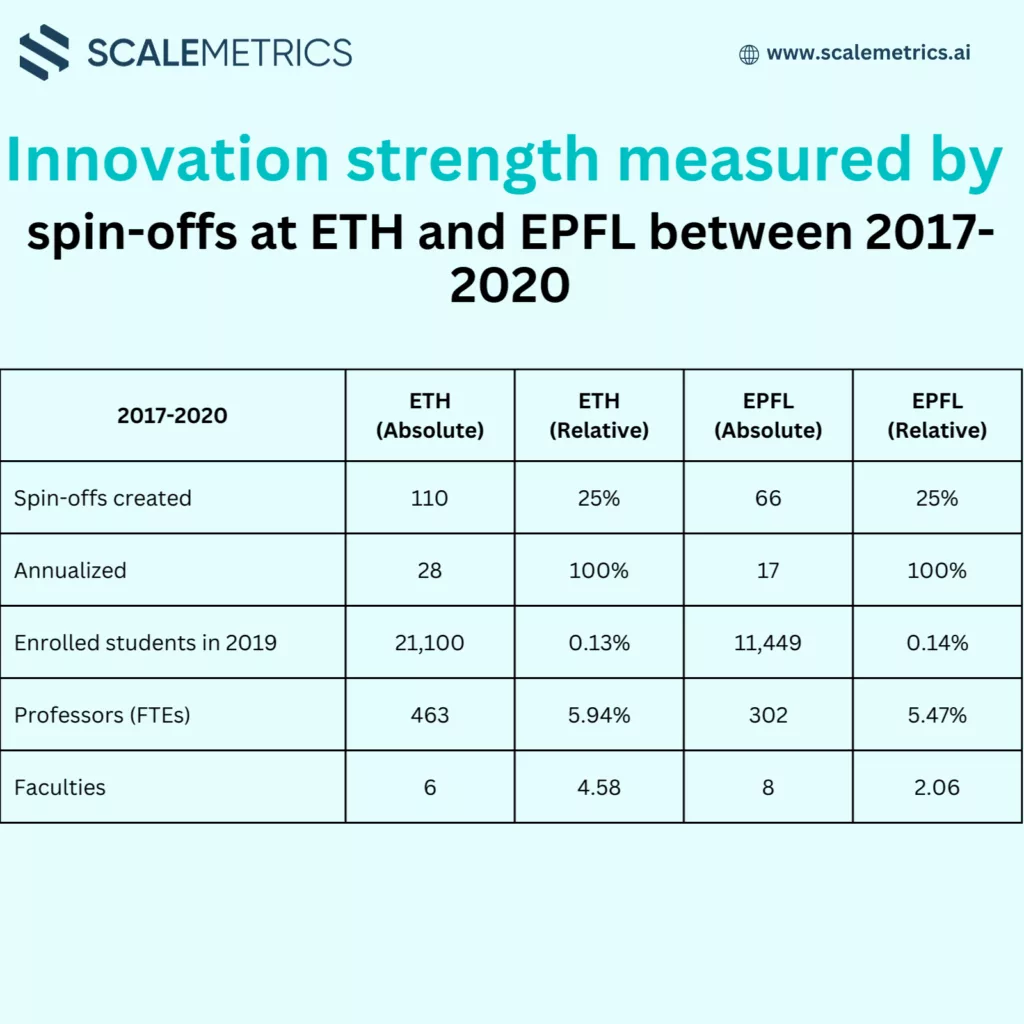
Quick Answer
Evaluate the innovation strength of ETH & EPFL spin-offs from 2017-2020. Learn key metrics and comparisons.
Spin-offs and Institutional Metrics
Annual Spin-offs Relative to Institutional Metrics
-
ETH Zurich (ETH):
- Annual Spin-offs: 28
- Enrolled Students: Approximately 21,500
- Full-time Equivalent Professors: 500
- Faculties: 16
-
EPFL:
- Annual Spin-offs: 17
- Enrolled Students: Approximately 12,000
- Full-time Equivalent Professors: 340
- Faculties: 5
Spin-offs per Student, Professor, and Faculty
When we compare the number of spin-offs relative to the number of students, professors, and faculties, some interesting patterns emerge.-
ETH Zurich (ETH):
- Spin-offs per Student: 1 per 767 students
- Spin-offs per Professor: 1 per 17 professors
- Spin-offs per Faculty: 1.75 per faculty
-
EPFL:
- Spin-offs per Student: 1 per 694 students
- Spin-offs per Professor: 1 per 20 professors
- Spin-offs per Faculty: 3.4 per faculty
Insights and Interpretation
Spin-offs per Student
EPFL shows a higher number of spin-offs per student compared to ETH. This suggests that EPFL students are more likely to engage in entrepreneurial activities and establish spin-offs. The entrepreneurial culture and support mechanisms at EPFL might be particularly effective in encouraging students to translate their research into commercial ventures.Spin-offs per Professor
ETH has a higher number of spin-offs per professor, indicating that the professors at ETH are more actively involved in founding spin-offs. This could be attributed to ETH’s strong emphasis on translating research into practical applications and its extensive support system for faculty entrepreneurship.Spin-offs per Faculty
The higher number of spin-offs per faculty at EPFL suggests that the institution’s faculties are highly entrepreneurial and may have more interdisciplinary projects that lead to spin-offs. EPFL’s concentrated faculty structure might also facilitate more collaborative and innovative projects, leading to a higher spin-off rate.Factors Contributing to Innovation Strength
Institutional Support and Resources
Both ETH and EPFL provide significant support to foster innovation and entrepreneurship. These include access to incubation centers, funding opportunities, mentorship programs, and networking events. This ecosystem is crucial for transforming research into viable commercial products and services.Research Excellence
Both institutions are renowned for their research excellence, which is a key driver of innovation. High-quality research often leads to groundbreaking technologies and solutions that can be commercialized through spin-offs.Collaborative Environment
A collaborative environment that encourages interdisciplinary projects can significantly boost the number of spin-offs. Both ETH and EPFL promote collaboration among different faculties and departments, leading to innovative solutions that address complex problems.Entrepreneurial Culture
The entrepreneurial culture at both institutions plays a vital role in encouraging students and faculty to pursue entrepreneurial ventures. Workshops, seminars, and competitions focused on entrepreneurship are common, providing the necessary skills and motivation to launch spin-offs.Case Studies of Notable Spin-offs
ETH Zurich Spin-offs
- Climeworks: Founded by ETH Zurich alumni, Climeworks specializes in direct air capture technology to combat climate change. It has grown into a leading company in the field of carbon capture and storage.
- Scandit: A leader in mobile computer vision and augmented reality solutions, Scandit was spun off from ETH Zurich. It provides barcode scanning technology used in retail, logistics, and healthcare.
EPFL Spin-offs
- MindMaze: A spin-off from EPFL, MindMaze develops neurotechnology and virtual reality products for healthcare. Its solutions are used for neurorehabilitation and brain-machine interfaces.
- Flyability: This EPFL spin-off creates collision-tolerant drones for industrial inspections. Its technology is used in hazardous environments, reducing the need for human intervention and improving safety.
Enhancing Your Spin-off’s Success
For those in the seed phase looking to enhance their spin-off’s success, consider focusing on the following points:- Target a Large Market:
- Ensure your market is sizable enough to attract significant investor interest. A larger market offers greater potential for growth and scalability.
- Develop Disruptive Technology:
- Create a technology that disrupts existing solutions and is difficult for competitors to replicate. This provides a competitive edge and makes your startup more appealing to investors.
- Build a Strong Team:
- Assemble a team with diverse skills and experience. Investors look for strong teams that can execute the business plan effectively.
- Pilot Projects:
- Conduct pilot projects with potential customers to demonstrate the viability and demand for your product. Successful pilots can provide proof of concept and attract early investment.
Conclusion
The innovation strength measured by spin-offs at ETH and EPFL between 2017 and 2020 reflects the robust entrepreneurial ecosystem at these institutions. While EPFL has a higher number of spin-offs per student, ETH excels in spin-offs per professor and faculty. Both institutions showcase a balanced and dynamic approach to fostering innovation and entrepreneurship. By leveraging institutional support, engaging in high-quality research, fostering collaboration, and cultivating an entrepreneurial culture, spin-offs from these institutions are well-positioned to succeed and drive forward technological advancements. For more detailed analysis and insights into the spin-off ecosystem, stay tuned for our upcoming reports and articles.Related Resources
Scalemetrics helps Swiss SMEs act on decisions like this before market conditions shift. Our corporate tax and VAT compliance services and outsourced CFO team give finance directors the senior expertise to move first.
Sources & References
Frequently Asked Questions
What financial services does Scalemetrics provide for Swiss SMEs?
Scalemetrics provides Swiss SME owners and CFOs with practical financial expertise: from accounting and tax compliance to financial planning, KPI monitoring, and on-demand CFO services. The goal is to give growing businesses access to senior financial leadership without the cost of a full-time hire.
When does a Swiss SME need a fractional CFO?
A fractional CFO becomes valuable from around CHF 1–2M in annual revenue, or ahead of specific events: bank financing applications, investor rounds, M&A, or rapid growth phases. The cost is a fraction of a full-time CFO salary, with expertise available immediately.
How does Scalemetrics differ from a traditional Swiss fiduciary firm?
Traditional fiduciary firms focus on tax compliance and year-end accounts. Scalemetrics adds strategic financial leadership: rolling forecasts, cash flow modelling, KPI dashboards, and financing advisory, delivered as an ongoing mandate or for a specific project.
Which Swiss cantons does Scalemetrics cover?
Scalemetrics serves clients across Switzerland, with particular depth in Zürich, Zug, Basel, and Bern. Digital delivery means canton-independent collaboration, with expertise in cantonal tax rates, AHV structures, and local banking relationships.
What does outsourced accounting for Swiss SMEs include?
Outsourced accounting for Swiss SMEs covers OR-compliant bookkeeping under Arts. 957–963b, monthly bank reconciliation, accounts payable and receivable management, payroll runs with AHV/BVG/UVG deductions, quarterly MWST filings, and monthly financial statement preparation, delivered by an external specialist without the fixed cost of an in-house team.
Which Swiss accounting standards apply to SMEs?
Swiss SMEs must maintain accounts under the Code of Obligations (OR), Arts. 957–963b, using accrual-basis bookkeeping with a balance sheet and income statement. Companies with turnover above CHF 500,000 or 10+ employees require a statutory limited audit (eingeschränkte Revision) unless all shareholders formally opt out.
Swiss University Spin-Offs as Innovation Benchmarks
The number and quality of spin-offs produced by a university is widely regarded as one of the most reliable measures of its translational research capability — the ability to convert scientific discovery into commercially viable businesses. Measured against this standard, ETH Zurich and EPFL stand among the leading universities globally, producing a consistent flow of spin-off companies that commercialise research outputs across life sciences, advanced materials, computing, robotics, and cleantech.
Between 2017 and 2022, ETH Zurich and EPFL collectively produced over 400 spin-off companies — a remarkable output for two institutions with combined student and researcher populations far smaller than the US research universities typically cited as global benchmarks. The spin-off production rate at ETH and EPFL exceeds that of most European institutions and compares favourably with Imperial College London, ETH's closest European peer on this measure.
The sectoral distribution of Swiss university spin-offs reflects the research strengths of both institutions. Life sciences and medtech represent the largest single category, driven by Switzerland's established life sciences cluster in Basel and the proximity of major pharmaceutical research facilities (Roche, Novartis, Johnson & Johnson) that provide both co-development partnerships and acquisition liquidity for spin-off exits. Advanced materials, robotics and automation, and software/AI are the other significant categories.
What the Spin-Off Data Tells Us About Swiss Innovation Quality
Spin-off count alone is an incomplete innovation strength metric. Equally important is the quality and scale of outcomes: how many spin-offs reached commercial viability, how much funding they raised, and what exit values they achieved. On these secondary metrics, ETH and EPFL spin-offs perform strongly relative to European peers, with a significant proportion of the 2017–2022 cohort having raised CHF 5 million or more in external financing — a threshold that indicates genuine commercial traction rather than academic prototyping.
The funding data reveals a meaningful performance gap between the two institutions in certain cohort years, with ETH spin-offs on average raising more capital at equivalent stages. This differential reflects structural factors: the Zurich ecosystem's deeper VC infrastructure, the established relationships between ETH's technology transfer office and major Swiss and international investors, and the concentration of pharma and financial services corporate venture capital in the Zurich-Basel corridor.
For Swiss SMEs and commercial enterprises that are not themselves spin-offs, the ETH/EPFL data provides valuable intelligence about where innovation will emerge and which technologies are likely to shape competitive landscapes in the next five to ten years. Tracking spin-off activity in your sector — and engaging early with commercially promising spin-offs as potential technology partners, customers, or acquisition targets — is a source of strategic advantage that many incumbent Swiss SMEs underutilise.
Implications for Swiss Innovation Financing
The strength of the ETH/EPFL spin-off ecosystem creates a compelling case for sustained public and private investment in Swiss university R&D. InnoSuisse, the Swiss Innovation Agency, provides the primary bridge between academic research and commercial application through its innovation vouchers, R&D contribution support, and start-up coaching programmes. The return on this public investment — measured in spin-off creation, job generation, and export value — appears high by international standards.
| Innovation Metric | ETH Zurich (2017–2022) | EPFL (2017–2022) |
|---|---|---|
| Spin-offs founded | ~250 | ~170 |
| Average first-round funding | Higher | Strong, growing |
| Dominant sector | Life sciences, DeepTech | Life sciences, ICT, cleantech |
| Primary investor ecosystem | Zurich / Basel VCs, corporate CVCs | Lausanne / Geneva, pan-European VCs |
For Swiss SMEs seeking to understand how innovation data informs strategic and investment decisions, our strategic CFO services provide the financial and commercial analysis that translates market intelligence into actionable business strategy.

Pascal Stämpfli leverages over a decade of expertise in corporate finance and venture capital to scale and optimize businesses. A CFA charterholder with a Master's in Economics from the University of St. Gallen, Pascal specializes in market & company assessments, strategy, and business value creation. Having assessed more than 1,000 companies for financial and strategic investors provides him with a sophisticated understanding of investor rationale and capital allocation. As the Managing Director of Scalemetrics and Managing Partner at COREangels Big Data & AI Europe, Pascal operates at the intersection of financial discipline and technological innovation.