
Annual contract value
Quick Answer
Learn how to calculate & optimize your Annual Contract Value to predict revenue and scale your business efficiently.
Understanding Annual Contract Value
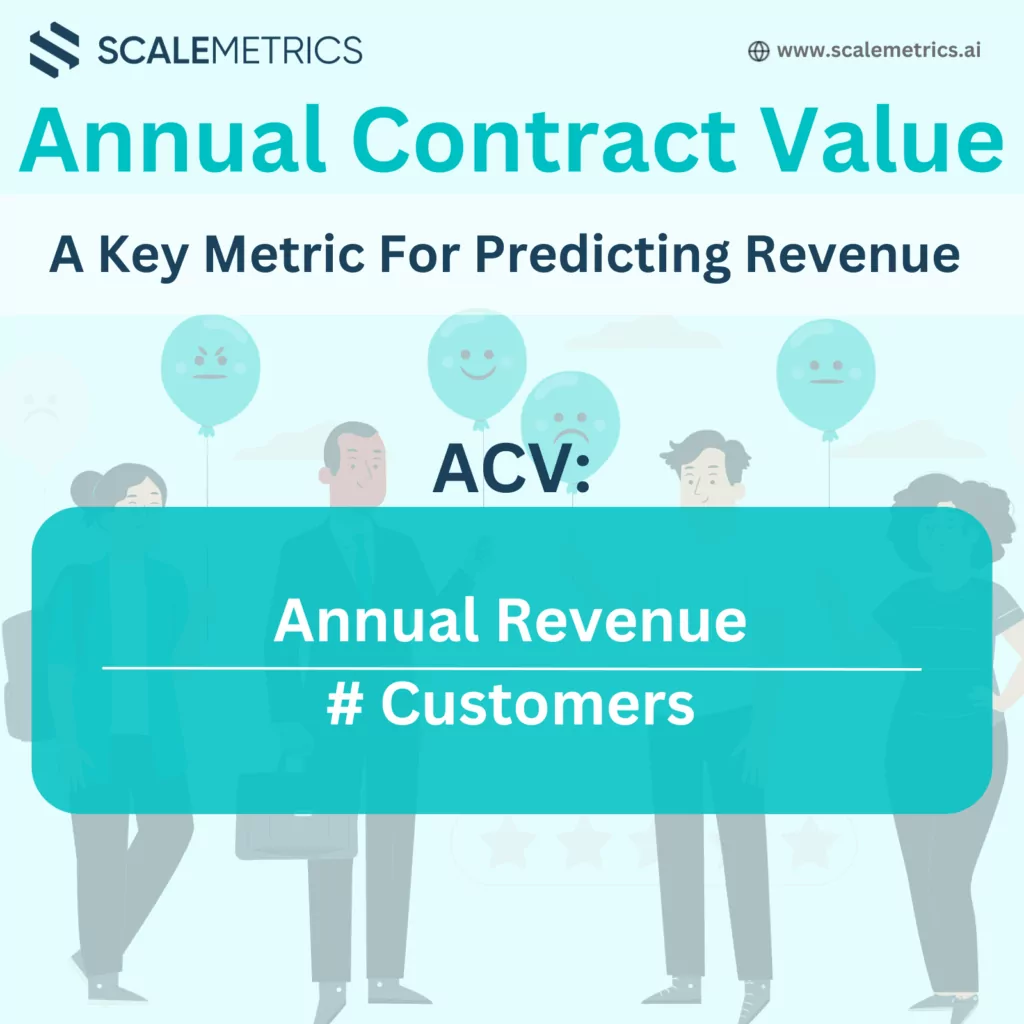
Annual contract value is the total revenue generated from a single customer contract over a year. It is particularly useful for subscription-based and service-oriented businesses, as it provides a consistent measure of recurring revenue from customers.How to Calculate Annual Contract Value
The method to calculate ACV varies depending on your business model:For SaaS Businesses:
- Annualise All Contracts: Determine the total value of all contracts on an annual basis.
- Sum Up All Contracts: Add the annualised values of all contracts.
- Divide by the Number of Contracts: This gives you the average annual contract value.
For Project-Based Businesses:
- Calculate Turnover for the Last Twelve Months: Determine the total turnover or revenue generated in the past year.
- Divide by the Number of Projects: This provides the average annual value per project.
Example Calculation
Suppose you run a SaaS business with the following contract values:- Contract 1: $1,200 annually
- Contract 2: $2,400 annually
- Contract 3: $3,600 annually
Importance of Annual Contract Value
Revenue Prediction
Knowing your ACV allows you to predict how many contracts you need to sign to reach your revenue targets. For example, if your revenue target for the year is $240,000 and your ACV is $2,400, you need to sign 100 contracts to achieve this target. Number of Contracts Needed=Revenue Target/ ACV=240,000/2,400=100Understanding Business Scalability
ACV also provides insights into the scalability of your business. By analyzing this metric, you can identify the limits of your current operating setting in terms of revenue and profitability.Example: Operational Limits
If your business operates at a 90% occupancy rate, reaching more than an additional 10% of customers may be difficult without optimizing your processes or hiring new staff. This constraint highlights the need to improve operational efficiency or expand capacity to accommodate more clients.Strategies to Increase Annual Contract Value
Optimize Processes
Improving your operational processes can help you serve more customers without compromising quality. Streamlining workflows, automating tasks, and enhancing efficiency are key steps in this direction.Hire Additional Staff
Expanding your team allows you to take on more projects or clients, thereby increasing your ACV. Hiring skilled professionals can help manage the increased workload and maintain high service standards.Offer Additional Services
Creating attractive additional services or upselling existing customers can significantly boost your ACV. For example, a SaaS company might offer premium features or add-on services at an extra cost, increasing the overall value of each contract.Personalized Customer Experience
Enhancing the customer experience by offering personalized services can lead to higher customer satisfaction and retention. Satisfied customers are more likely to renew contracts and opt for additional services, thereby increasing ACV.Conclusion
Annual contract value is a vital metric for predicting revenue and understanding the scalability of your business. By accurately calculating and analyzing ACV, you can set realistic revenue targets, identify operational constraints, and implement strategies to increase revenue without necessarily expanding your customer base. This metric helps you make informed decisions that drive business growth and profitability.Related Resources
Scalemetrics helps Swiss SMEs act on decisions like this before market conditions shift. Our budgeting and financial forecasting services and outsourced CFO team give finance directors the senior expertise to move first.
Sources & References
Frequently Asked Questions
What financial services does Scalemetrics provide for Swiss SMEs?
Scalemetrics provides Swiss SME owners and CFOs with practical financial expertise: from accounting and tax compliance to financial planning, KPI monitoring, and on-demand CFO services. The goal is to give growing businesses access to senior financial leadership without the cost of a full-time hire.
When does a Swiss SME need a fractional CFO?
A fractional CFO becomes valuable from around CHF 1–2M in annual revenue, or ahead of specific events: bank financing applications, investor rounds, M&A, or rapid growth phases. The cost is a fraction of a full-time CFO salary, with expertise available immediately.
How does Scalemetrics differ from a traditional Swiss fiduciary firm?
Traditional fiduciary firms focus on tax compliance and year-end accounts. Scalemetrics adds strategic financial leadership: rolling forecasts, cash flow modelling, KPI dashboards, and financing advisory, delivered as an ongoing mandate or for a specific project.
What financial metrics matter most for Swiss SME growth?
The most important financial metrics for Swiss SME growth are gross margin, EBITDA margin, working capital ratio, cash conversion cycle, and monthly cash burn. A fractional CFO builds KPI dashboards tracking these against budget monthly, enabling data-driven decisions rather than reactive cash management.
How does a fractional CFO support Swiss SME scaling?
A fractional CFO supports Swiss SME scaling by building the financial infrastructure needed for growth: management reporting, budgeting and forecasting, financial modelling for new market entry or hiring decisions, investor-grade reporting for fundraising, and tax optimisation across cantons. Scalemetrics provides this as a fully outsourced CFO mandate from CHF 3,000/month.
What Is Annual Contract Value and Why Does It Matter for Swiss SMEs?
Annual contract value (ACV) measures the average annualised revenue generated from a single customer contract, excluding one-off implementation or set-up fees. For Swiss SaaS companies, managed service providers, and subscription-based businesses, ACV is a foundational metric that drives virtually every other financial calculation — from sales team sizing to investor valuation.
ACV differs from total contract value (TCV) in that it normalises multi-year contracts to a per-year basis. A three-year contract worth CHF 90,000 has a TCV of CHF 90,000 but an ACV of CHF 30,000. This normalisation is essential when comparing contracts of varying lengths or when assessing the productivity of your sales team across different deal structures.
For Swiss SMEs, the distinction becomes commercially significant when structuring contracts for cantonal or federal government clients, where multi-year commitments are common but annual budget approvals create implicit re-pricing risk at each renewal. Tracking ACV alongside net revenue retention (NRR) gives management a clear picture of whether the customer base is expanding or contracting on an annualised basis.
ACV as a Driver of Operational and Financial Planning
ACV directly determines the appropriate investment in sales and customer success. A business with an average ACV of CHF 5,000 cannot economically sustain a direct sales force using traditional Swiss salary benchmarks — the fully-loaded cost of a sales executive (CHF 130,000–160,000 including AHV at 5.3%, BVG at 8–12%, and ancillary costs) would require each rep to close 30–40 new customers per year to generate a 3:1 CLV:CAC ratio. At that ACV, product-led growth, inbound marketing, or low-touch inside sales are the rational model.
Conversely, an ACV of CHF 50,000 or above justifies an enterprise sales motion with dedicated account executives, solution consultants, and relationship management. The unit economics at this level support the Swiss cost structure and allow for the long sales cycles typical of larger Swiss enterprise and public sector deals.
For financial planning purposes, ACV feeds directly into ARR (annual recurring revenue) modelling, which is the basis for SaaS valuation multiples. Swiss SaaS companies with consistent ARR growth and strong net retention are increasingly attracting attention from Swiss and European institutional investors. Presenting clean ACV and ARR data — ideally segmented by customer cohort, industry vertical, and contract length — is a prerequisite for any serious fundraising process.
Benchmarking ACV in the Swiss Market
Swiss market ACV benchmarks vary widely by sector. B2B software businesses targeting Swiss SMEs typically see ACV in the CHF 10,000–40,000 range. Those targeting large enterprises or financial institutions may achieve CHF 100,000+ ACV but with longer sales cycles and higher service costs. Cross-border comparison is difficult because Swiss ACV figures are often stated in CHF and reflect premium market positioning relative to EUR-denominated competitors.
| ACV Range (CHF) | Appropriate Sales Model | Typical CAC Payback Target |
|---|---|---|
| < CHF 5,000 | Product-led / inbound self-serve | < 6 months |
| CHF 5,000–25,000 | Inside sales / low-touch | 6–12 months |
| CHF 25,000–100,000 | Field sales / mid-market motion | 12–18 months |
| > CHF 100,000 | Enterprise / strategic accounts | 18–24 months |
To integrate ACV tracking into your financial reporting and build investor-ready ARR models for your Swiss SME, our financial reporting services provide the frameworks and expertise you need.

Pascal Stämpfli leverages over a decade of expertise in corporate finance and venture capital to scale and optimize businesses. A CFA charterholder with a Master's in Economics from the University of St. Gallen, Pascal specializes in market & company assessments, strategy, and business value creation. Having assessed more than 1,000 companies for financial and strategic investors provides him with a sophisticated understanding of investor rationale and capital allocation. As the Managing Director of Scalemetrics and Managing Partner at COREangels Big Data & AI Europe, Pascal operates at the intersection of financial discipline and technological innovation.