
Understanding and Optimizing Lead Conversion Rate
Quick Answer
Learn how to calculate and optimize your lead conversion rate to enhance sales efficiency and maximize marketing ROI.
Importance of Lead Conversion Rate
The lead conversion rate provides critical insights into:- Sales Efficiency: Helps understand the effectiveness of your sales process.
- Marketing ROI: Assesses which channels and campaigns are delivering the best results.
- Customer Targeting: Identifies the most profitable customer segments.
- Product/Service Appeal: Indicates whether your offerings meet market expectations.
Calculating Lead Conversion Rate
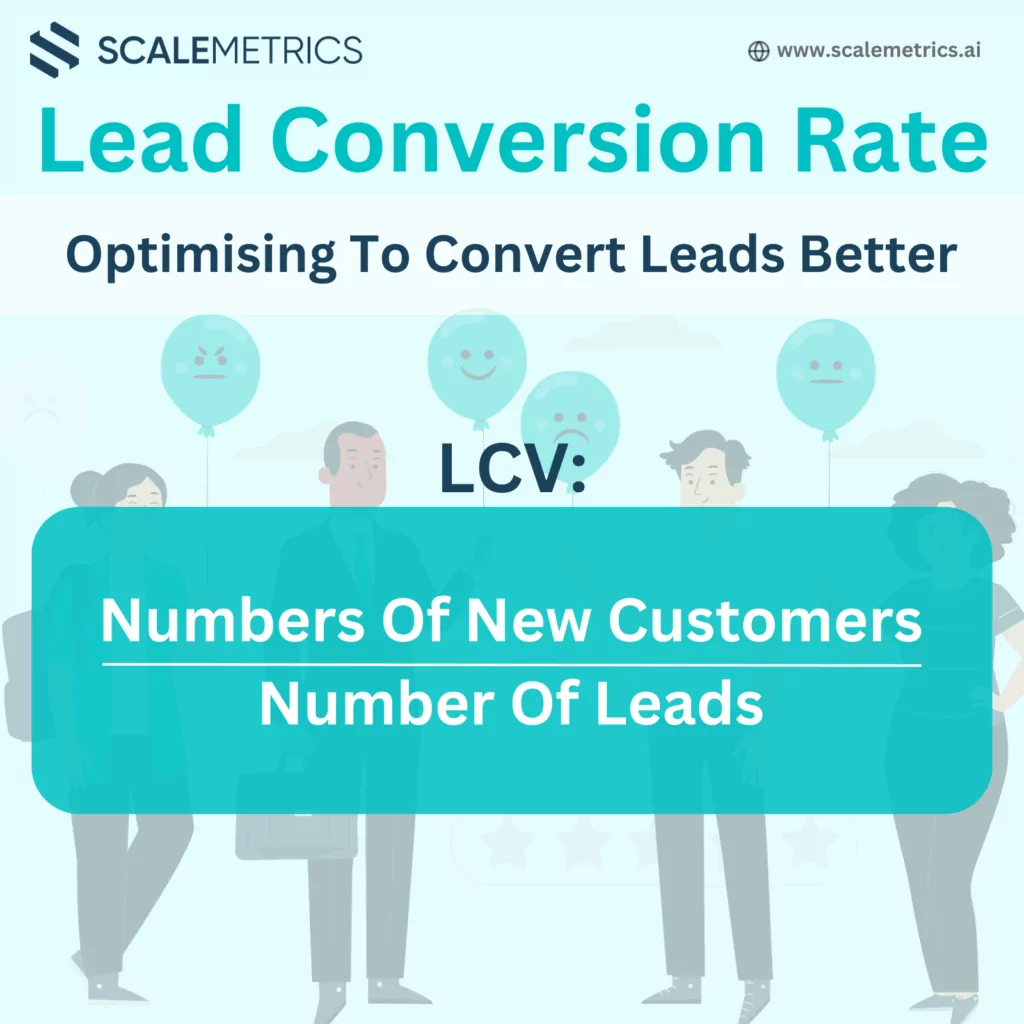
The formula for calculating the lead conversion rate is straightforward: Lead Conversion Rate=Number of New Customers/Number of LeadsTypes of Conversion Rates
- Overall Conversion Rate: This is the simplest form, calculated by dividing the total number of new customers by the total number of leads.
- Channel-Specific Conversion Rate: Measures the conversion rate for leads coming from specific marketing channels (e.g., social media, email campaigns, paid ads).
- Segment-Specific Conversion Rate: Focuses on different customer segments to see which ones convert at higher rates.
Example Calculation
Suppose your company acquired 100 new customers in a month and had 1,000 leads during the same period. The lead conversion rate would be:Determining Actual Number of Leads
While it is relatively easy to determine and add up your new customers, it becomes more difficult to determine the actual number of leads. For example, should you consider every visitor to your company’s website as a lead or only when you or one of your employees is in contact with a potential customer?Optimizing Lead Conversion Rate
- Improve Lead Quality: Focus on generating high-quality leads that are more likely to convert. This can be achieved through targeted marketing campaigns and effective lead scoring systems.
- Enhance Lead Nurturing: Implement strategies to nurture leads through personalized communication and follow-ups. Use email marketing, social media engagement, and content marketing to keep leads engaged.
- Refine Sales Processes: Streamline your sales processes to reduce friction and improve efficiency. Train your sales team on best practices for lead conversion.
- Analyze Customer Feedback: Regularly seek and analyze customer feedback to identify areas for improvement in your product or service. Addressing these issues can make your offerings more attractive to potential customers.
- Use Data Analytics: Leverage data analytics to track and analyze lead conversion rates across different channels and segments. Use these insights to make data-driven decisions and optimize your strategies.
Real-World Example
HubSpot: As a leading CRM platform, HubSpot uses lead conversion rate metrics to optimize its marketing and sales strategies. By closely monitoring conversion rates across different channels, HubSpot continually refines its approach to improve efficiency and drive revenue growth. This data-driven methodology has contributed to its success and market leadership.Conclusion
Understanding and optimizing your lead conversion rate is crucial for maximizing the efficiency of your marketing and sales efforts. By calculating this metric and analyzing it across different channels and customer segments, you can make informed decisions that enhance your overall business performance. Implementing strategies to improve lead quality, streamline sales processes, and use data analytics will help you achieve higher conversion rates and drive sustainable growth.Related Resources
Scalemetrics helps Swiss SMEs act on decisions like this before market conditions shift. Our financial due diligence services and outsourced CFO team give finance directors the senior expertise to move first.
Sources & References
Frequently Asked Questions
What financial services does Scalemetrics provide for Swiss SMEs?
Scalemetrics provides Swiss SME owners and CFOs with practical financial expertise: from accounting and tax compliance to financial planning, KPI monitoring, and on-demand CFO services. The goal is to give growing businesses access to senior financial leadership without the cost of a full-time hire.
When does a Swiss SME need a fractional CFO?
A fractional CFO becomes valuable from around CHF 1–2M in annual revenue, or ahead of specific events: bank financing applications, investor rounds, M&A, or rapid growth phases. The cost is a fraction of a full-time CFO salary, with expertise available immediately.
How does Scalemetrics differ from a traditional Swiss fiduciary firm?
Traditional fiduciary firms focus on tax compliance and year-end accounts. Scalemetrics adds strategic financial leadership: rolling forecasts, cash flow modelling, KPI dashboards, and financing advisory, delivered as an ongoing mandate or for a specific project.
Which Swiss cantons does Scalemetrics cover?
Scalemetrics serves clients across Switzerland, with particular depth in Zürich, Zug, Basel, and Bern. Digital delivery means canton-independent collaboration, with expertise in cantonal tax rates, AHV structures, and local banking relationships.
Understanding Lead Conversion Rate as a Financial Metric
Lead conversion rate (LCR) — the percentage of sales-qualified leads that ultimately become paying customers — is one of the most consequential metrics in a Swiss SME's commercial model. It determines the volume of leads required to meet a revenue target, the appropriate size of the sales team, and the CAC at any given level of marketing investment. A 5% conversion rate requires 20 leads to close one customer; a 20% conversion rate requires only five. That four-fold difference in lead volume has direct, material implications for your marketing budget, sales headcount, and cost structure.
For Swiss B2B SMEs, where the market is relatively small and the fully-loaded cost of a sales professional is CHF 120,000–160,000 per year (including AHV employer contribution at 5.3%, BVG pension at 8–12%, and associated overhead), conversion rate optimisation is a higher-leverage activity than simply adding more leads to the top of the funnel. Improving conversion from 10% to 15% is equivalent to hiring an additional salesperson — at zero incremental cost.
Diagnosing Conversion Rate Problems by Funnel Stage
Low overall conversion rates are rarely a single-point failure. They reflect weaknesses at specific stages of the sales funnel: lead qualification (are the right prospects entering the funnel?), initial discovery (is the value proposition compelling and differentiated?), proposal quality (does the commercial offer reflect genuine understanding of the prospect's situation?), or objection handling (is the sales team equipped to address price, risk, and competitive concerns?)
Swiss SMEs serving the domestic market face specific conversion challenges. Swiss buyers are price-conscious, reference-driven, and risk-averse. They require social proof from credible Swiss-market references, and they respond poorly to high-pressure sales tactics. Conversion rates in Swiss B2B markets are typically 10–15% for well-positioned SMEs but can fall significantly below that for companies without established Swiss market presence or relevant case studies.
MWST implications also affect conversion dynamics. B2B buyers who can recover VAT at 8.1% are less price-sensitive to gross invoice amounts than consumers or non-VAT-registered entities. Structuring proposals with clear net-of-VAT pricing for B2B prospects, whilst complying with Swiss invoicing requirements under MWST law, reflects commercial sophistication that builds buyer confidence.
Building a Conversion Optimisation System
Systematic conversion rate improvement requires measurement infrastructure: a CRM that tracks deals by stage, clear stage-entry and stage-exit criteria, and regular deal review cadences where conversion data is analysed at each funnel step. Without this infrastructure, conversion optimisation is anecdotal rather than systematic.
| Funnel Stage | Swiss B2B Benchmark Conversion | Key Optimisation Lever |
|---|---|---|
| Lead → Qualified Opportunity | 20–35% | ICP definition, lead scoring criteria |
| Qualified Opportunity → Proposal | 50–70% | Discovery call quality, needs alignment |
| Proposal → Closed Won | 25–45% | Proposal quality, reference availability, pricing |
| Overall Lead → Customer | 10–20% | End-to-end sales process quality |
To integrate lead conversion tracking into your financial controlling framework and understand the true CAC implications of your current conversion rates, explore our financial controlling services for Swiss SMEs.

Pascal Stämpfli leverages over a decade of expertise in corporate finance and venture capital to scale and optimize businesses. A CFA charterholder with a Master's in Economics from the University of St. Gallen, Pascal specializes in market & company assessments, strategy, and business value creation. Having assessed more than 1,000 companies for financial and strategic investors provides him with a sophisticated understanding of investor rationale and capital allocation. As the Managing Director of Scalemetrics and Managing Partner at COREangels Big Data & AI Europe, Pascal operates at the intersection of financial discipline and technological innovation.