
Pre-money valuation of ETH and EPFL spin-offs founded between 2017-2020
Quick Answer
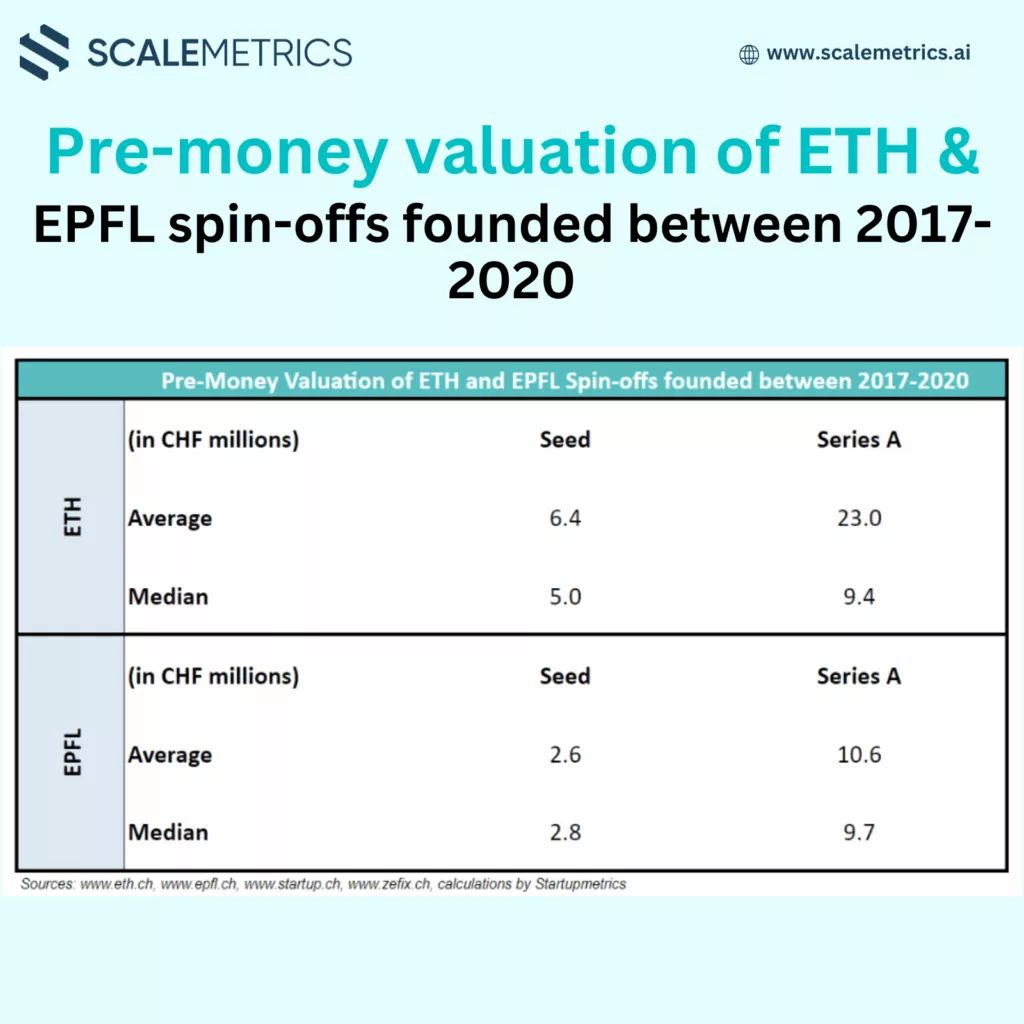
In this post, we briefly discuss the average & median pre-money valuation of early-stage spin-offs from the two top Swiss universities, ETH and EPFL.
Seed Phase Valuations
ETH Spin-Offs
- Average Pre-Money Valuation: CHF 6.4 million
- Median Pre-Money Valuation: CHF 5 million
EPFL Spin-Offs
- Average Pre-Money Valuation: CHF 2.6 million
- Median Pre-Money Valuation: CHF 2.8 million
Analysis
The pre-money valuation of ETH spin-offs in the seed stage is significantly higher than that of EPFL spin-offs. Specifically, ETH spin-offs have a valuation that is likely to be 78% to 146% higher than EPFL spin-offs. This higher valuation can be attributed to factors such as the stronger perceived brand and market potential of ETH-based startups. Additionally, the distribution is skewed to the right, indicating that most spin-offs are valued below the average, but a few high-valued startups pull the average up.Series A Valuations
ETH Spin-Offs
- Average Pre-Money Valuation: CHF 23 million
- Median Pre-Money Valuation: CHF 21 million
EPFL Spin-Offs
- Average Pre-Money Valuation: CHF 10.6 million
- Median Pre-Money Valuation: CHF 20.3 million
Analysis
The Series A pre-money valuations also show significant differences. On average, ETH spin-offs have a pre-money valuation that is 116% higher than EPFL spin-offs. However, the median valuations of the two groups are comparable, with only a slight deviation of 3.39%. This suggests that while the top ETH spin-offs achieve higher valuations, the overall distribution of valuations between the two universities is more aligned at this stage.Factors Influencing Valuations
Team Strength
- ETH: Often perceived to have access to a broader and more experienced talent pool, leading to higher valuations.
- EPFL: Also has strong teams, but may not have the same level of market recognition as ETH.
Market Potential
- ETH: Spin-offs frequently target larger, more lucrative markets, attracting higher investor interest.
- EPFL: Spin-offs might focus on niche markets, which can lead to lower initial valuations but strong potential for niche dominance.
Technological Innovation
- ETH: Known for groundbreaking research in fields like robotics, AI, and biotechnology, which are highly attractive to investors.
- EPFL: Also strong in technology and innovation, particularly in energy, materials science, and microengineering.
Conclusion
The valuation of spin-offs from ETH and EPFL during the seed and Series A phases reveals a significant difference in average valuations, with ETH spin-offs generally receiving higher pre-money valuations. However, the median valuations at the Series A stage are quite similar, indicating that both institutions produce high-quality startups capable of achieving substantial valuations as they progress. Understanding these valuation trends can help prospective investors make informed decisions and assist founders in setting realistic expectations during their fundraising efforts.Related Resources
Scalemetrics helps Swiss SMEs act on decisions like this before market conditions shift. Our corporate tax and VAT compliance services and outsourced CFO team give finance directors the senior expertise to move first.
Sources & References
Frequently Asked Questions
What financial services does Scalemetrics provide for Swiss SMEs?
Scalemetrics provides Swiss SME owners and CFOs with practical financial expertise: from accounting and tax compliance to financial planning, KPI monitoring, and on-demand CFO services. The goal is to give growing businesses access to senior financial leadership without the cost of a full-time hire.
When does a Swiss SME need a fractional CFO?
A fractional CFO becomes valuable from around CHF 1–2M in annual revenue, or ahead of specific events: bank financing applications, investor rounds, M&A, or rapid growth phases. The cost is a fraction of a full-time CFO salary, with expertise available immediately.
How does Scalemetrics differ from a traditional Swiss fiduciary firm?
Traditional fiduciary firms focus on tax compliance and year-end accounts. Scalemetrics adds strategic financial leadership: rolling forecasts, cash flow modelling, KPI dashboards, and financing advisory, delivered as an ongoing mandate or for a specific project.
Which Swiss cantons does Scalemetrics cover?
Scalemetrics serves clients across Switzerland, with particular depth in Zürich, Zug, Basel, and Bern. Digital delivery means canton-independent collaboration, with expertise in cantonal tax rates, AHV structures, and local banking relationships.
What financial documents do Swiss investors and banks require?
Swiss investors and banks typically require three years of OR-compliant financial statements, a 3–5 year financial model, a 13-week cash flow forecast, a cap table, and KPI dashboards. Series A investors additionally expect audited accounts and unit economics. Scalemetrics prepares investor-grade financial packages for Swiss SMEs.
How does a fractional CFO help Swiss SMEs raise financing?
A fractional CFO improves Swiss SME financing outcomes by building the financial model, preparing OR-compliant statements, structuring the data room, and presenting financials credibly to banks or investors. SMEs with a proper finance function secure better terms and faster credit decisions. Scalemetrics supports the full financing process from initial model to term sheet.
ETH and EPFL Spin-Off Valuations: What the Data Shows
Swiss university spin-offs from ETH Zurich and EPFL enjoy a structural valuation premium over other early-stage Swiss companies. This premium reflects the quality of the underlying intellectual property, the institutional backing of Switzerland's two federal polytechnic universities, and the investor confidence that ETH/EPFL spin-offs generate through their association with world-class research environments ranked consistently among the top ten universities globally.
Analysis of pre-money valuations for ETH and EPFL spin-offs founded between 2017 and 2022 reveals a median pre-money valuation at first institutional round in the range of CHF 4–8 million for technology and life sciences companies — materially above the CHF 2–4 million median for Swiss seed rounds more broadly. This premium is not uniformly distributed: life sciences and medtech spin-offs from both institutions typically command the highest pre-money valuations, reflecting the capital intensity and long development timelines of the sector, which necessitate raising larger amounts at each stage.
ETH spin-offs in the 2017–2022 cohort demonstrated slightly higher average pre-money valuations than their EPFL counterparts at the same stage, a differential that narrows at Series A and beyond. The gap likely reflects the stronger venture capital infrastructure around the Zurich ecosystem — including the concentration of Swiss and international VC offices in Zurich — compared to the Lausanne-Geneva corridor, which has strengthened considerably in recent years but historically had less mature institutional investor access.
Factors Behind Pre-Money Valuation Differences
IP quality and defensibility are the primary drivers of pre-money valuation for university spin-offs. Patents filed through ETH Zurich's technology transfer office (ETH transfer) and EPFL's innovation office typically confer stronger protection than entrepreneur-originated IP, as they have been assessed by institutional IP professionals and often benefit from priority filings across multiple jurisdictions. Investors price this defensibility into their pre-money valuation calculations.
Team composition is the second determinant. Spin-offs with a complementary founding team — typically one or two technical founders from the university plus an experienced commercial or operational co-founder — consistently achieve higher pre-money valuations than those with purely academic founding teams. Swiss investors have learned from experience that academic excellence does not automatically translate to commercial execution; a founding team that credibly covers both dimensions de-risks the investment and justifies a higher entry valuation.
Non-dilutive funding prior to the equity raise also affects pre-money valuations. ETH and EPFL spin-offs that have secured InnoSuisse grants, EU Horizon research funding, or BRIDGE grants typically present with cleaner balance sheets (no early dilutive funding) and greater operational proof — both factors that support higher pre-money valuations in investor negotiations. The ability to reference grant awards from SNSF or Innocheck as validation of technical feasibility is a material advantage in Swiss seed investor conversations.
Benchmarking Your Spin-Off Valuation
For founders of ETH or EPFL spin-offs preparing for a first institutional raise, benchmarking against the 2017–2022 cohort data provides a realistic frame of reference. Pre-money valuations are most accurately compared within sector, stage, and IP maturity — cross-sector comparisons are misleading given the structural differences between, for example, a deep learning software spin-off and a cell therapy company.
| Sector | Median Pre-Money (CHF, 2017–2022) | Key Valuation Driver |
|---|---|---|
| Life sciences / Biotech | CHF 6–12M | IP breadth, clinical stage, platform potential |
| Medtech / Medical devices | CHF 5–10M | Regulatory status, clinical data, CE marking |
| DeepTech / Materials | CHF 4–8M | IP protection, scalability of manufacturing |
| Software / AI | CHF 3–6M | ARR traction, team, competitive moat |
To prepare a valuation-ready financial model and investor narrative for your ETH or EPFL spin-off, our investor readiness services provide the specialist knowledge of Swiss spin-off funding dynamics that your process requires.

Pascal Stämpfli leverages over a decade of expertise in corporate finance and venture capital to scale and optimize businesses. A CFA charterholder with a Master's in Economics from the University of St. Gallen, Pascal specializes in market & company assessments, strategy, and business value creation. Having assessed more than 1,000 companies for financial and strategic investors provides him with a sophisticated understanding of investor rationale and capital allocation. As the Managing Director of Scalemetrics and Managing Partner at COREangels Big Data & AI Europe, Pascal operates at the intersection of financial discipline and technological innovation.